Nobel Controversy: Navi Pillay Wins Peace Prize Amid Israel Condemnation and US Sanctions on ICC
جنجال نوبل صلح: اعطای جایزه به ناوی پیلای همزمان با تحریم دیوان کیفری بینالمللی توسط آمریکا
South African jurist Navi Pillay has been awarded the Nobel Peace Prize for her work on human rights, sparking immediate condemnation from Israel. Meanwhile, the US administration has escalated its battle against international legal bodies by imposing sanctions on the ICC.
At time of publishing
USD
267,300
Toman
Gold 18K
26.51M
Toman / gram
Bitcoin
$82,445
US Dollar
Tether
266,999
Toman
Nobel Peace Prize Awarded Amid Geopolitical Friction
In a move that has sent shockwaves through the diplomatic world, South African jurist Navi Pillay has been awarded the Nobel Peace Prize for 2026. Pillay, a formidable figure in international law, was recognized for her lifelong commitment to human rights and her roles in various international tribunals. However, the selection has immediately become a lightning rod for controversy. The Israeli government issued a blistering condemnation, citing Pillay’s leadership of a United Nations commission that accused Israel of committing genocide against Palestinians in Gaza. This award is seen by many as a symbolic endorsement of the legal challenges facing Israel on the global stage, further deepening the rift between international human rights bodies and the Jewish state.
Beyond the immediate reaction from Jerusalem, the award highlights the growing influence of the 'Global South' in defining the narrative of international justice. Pillay’s career, which includes serving as a judge on the International Criminal Tribunal for Rwanda and as the UN High Commissioner for Human Rights, represents a shift toward holding powerful actors accountable for war crimes. For global markets, such a high-profile endorsement of a critic of Israeli policy adds a layer of diplomatic uncertainty, potentially affecting risk appetite in the Middle East as the conflict in Gaza remains a primary driver of regional instability.

US Sanctions on ICC: An Assault on the Rule of Law?
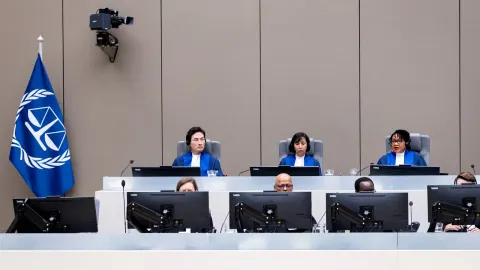
The geopolitical landscape grew even more complex this Friday as the United States unveiled a new round of sanctions against the International Criminal Court (ICC). The move, described by the court as an "unprecedented assault on the rule of law," comes in response to the ICC's investigations into alleged war crimes that involve US allies. The sanctions include travel bans and asset freezes on court officials, a tactic that has drawn sharp criticism even from Washington’s closest partners. The United Kingdom, along with several other member states of the tribunal, issued statements saying they "strongly disagree" with the American position, signaling a rare and public fracture in the Transatlantic alliance over international legal standards.
This escalation by the Trump administration reflects a broader strategy of prioritizing national sovereignty over international multilateral institutions. By targeting the ICC, the US is effectively signaling that it will not tolerate external judicial oversight of its military or diplomatic actions. For the Iranian market and regional observers, this move is particularly significant; it suggests that the US is willing to dismantle international legal frameworks to protect its interests, which could have long-term implications for how sanctions and international law are applied to Tehran. If the ICC's authority is undermined by the world's largest economy, the very concept of a "rules-based international order" faces an existential crisis.

Microsoft Nears $4 Trillion Milestone as AI Revival Solidifies
In the world of technology and finance, Microsoft is on the verge of a historic milestone, nearing a $4 trillion market capitalization. This surge is a direct result of the company's successful pivot to artificial intelligence and its integration of generative AI across its software suite. Analysts suggest that Microsoft’s ability to monetize AI through its Azure cloud services and Copilot tools has solidified its position as the leader of the current tech cycle. This growth comes at a time when other AI-focused firms are facing skepticism, proving that established giants with deep integration capabilities are currently winning the "AI war."
For investors in Iran and abroad, Microsoft’s ascent serves as a barometer for the health of the global tech sector. While the Iranian Rial (USD/IRR) saw a slight decrease today, moving from 267,700 to 267,300 (-0.1%), the strength of US tech stocks continues to drive global liquidity. Meanwhile, the gold market in Tehran showed resilience; Gold 18k per gram rose from 26,305,461 to 26,508,610 Toman (+0.8%), reflecting a persistent demand for safe-haven assets even as tech stocks reach record highs. The divergence between the booming US tech sector and the cautious local gold market highlights the dual nature of current global economics: high-growth optimism in Silicon Valley versus geopolitical hedging in the Middle East.
NASA Releases 1 TB of Artemis II Mission Data
NASA has taken a significant step toward transparency and collaborative science by making nearly 1 terabyte of data from the Artemis II mission available to the public. This massive data drop includes high-resolution photographs, audio recordings, and detailed notes from the astronauts involved in the mission to orbit the moon. By opening this data to researchers and the public, NASA aims to accelerate the study of lunar environments and prepare for the next phase of human exploration: landing on the moon’s surface. This move is part of a broader trend where space agencies are moving away from proprietary secrecy toward an "open science" model to foster innovation.

The release of this data is not just a win for scientists but also for the burgeoning private space industry. Startups and tech companies can now use this raw data to develop new navigation algorithms, life-support systems, and communication tools. In the context of global competition, NASA's openness contrasts with the more secretive programs of other space-faring nations. As space becomes a new frontier for economic competition, the ability to process and utilize such massive datasets will likely determine which nations and companies lead the next industrial revolution beyond Earth’s atmosphere.
Frequently Asked Questions
چرا اعطای جایزه نوبل صلح به ناوی پیلای جنجالی شده است؟
دلیل تحریم دیوان کیفری بینالمللی (ICC) توسط آمریکا چیست؟
وضعیت بازار طلا و ارز در تهران امروز چگونه بود؟
The International Criminal Court (ICC): Upholding Justice Amidst Geopolitical Tensions
The news headline touches upon the International Criminal Court (ICC), an institution at the forefront of international justice, yet frequently embroiled in controversy. Established by the Rome Statute in 2002, the ICC is a permanent court tasked with investigating and prosecuting individuals accused of the gravest international crimes: genocide, crimes against humanity, war crimes, and the crime of aggression. Its creation marked a significant step in international law, aiming to ensure accountability for atrocities that might otherwise go unpunished by national courts.
A core principle of the ICC is its role as a court of last resort. This means it only exercises jurisdiction when national courts are unwilling or genuinely unable to carry out investigations or prosecutions. This delicate balance attempts to respect state sovereignty while providing a crucial backstop for justice. However, this principle is often a source of tension, as some powerful nations view the ICC's potential jurisdiction over their citizens as an infringement on their national sovereignty, particularly when their own judicial systems are deemed capable.
Indeed, the ICC frequently faces significant geopolitical challenges, as highlighted by the mention of US sanctions and Israel's condemnation. The United States, while supportive of some international justice efforts, has historically not ratified the Rome Statute and has at times imposed sanctions on ICC officials when investigations touched upon its personnel or allies. Similarly, Israel, also not a signatory, has vehemently rejected the ICC's jurisdiction over actions in its territories, viewing such probes as politically motivated and illegitimate. These instances underscore the persistent struggle between the universal aspiration for justice and the realities of state power and national interests.
Despite these formidable obstacles, the ICC remains a vital institution for victims of mass atrocities worldwide. Its very existence sends a powerful message that impunity for the most heinous crimes will not be tolerated indefinitely. While its enforcement capabilities are limited by the cooperation of member states and the absence of its own police force, the ICC continues to shape the landscape of international criminal law, influencing national legal systems and serving as a beacon for human rights and accountability.
Topics
Related Articles