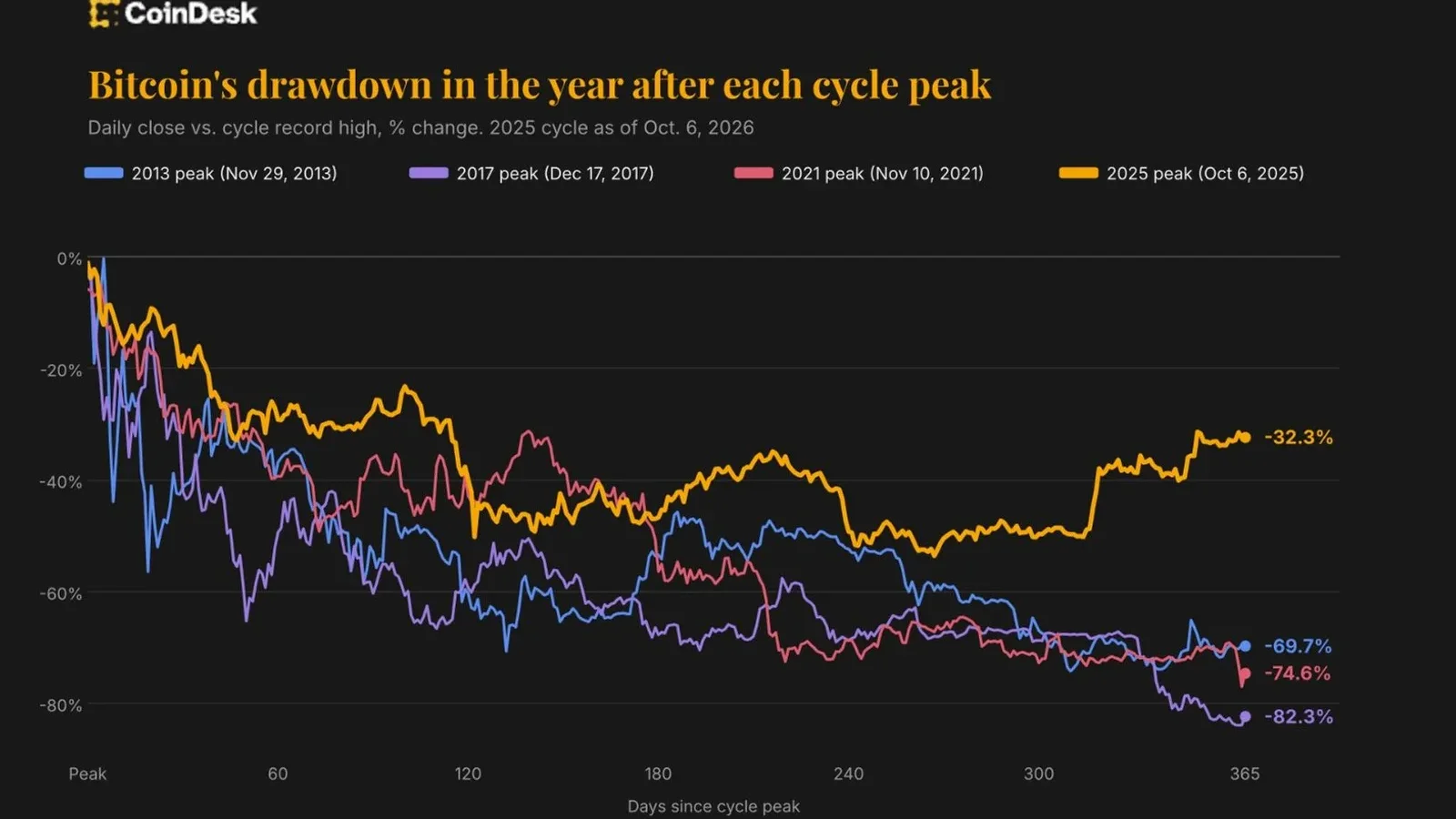
Bitcoin's 'Milder' Bear Market: Is a 32% Drop from ATH a Sign of Maturity or a New Normal?
بازار نزولی «ملایمتر» بیتکوین: آیا افت ۳۲ درصدی از اوج تاریخی نشانه بلوغ است یا هنجاری جدید؟
A year after reaching its all-time high of $126,000, Bitcoin is down 'just' 32%, a significantly shallower decline compared to past crypto bear markets. This trend raises questions about the asset's evolving maturity and its resilience to global economic shifts. For Iranian investors, understanding these dynamics is crucial for navigating local crypto markets and leveraging assets like USDT.
At time of publishing
USD
269,600
Toman
Gold 18K
26.69M
Toman / gram
Bitcoin
$85,762
US Dollar
Tether
268,200
Toman
Bitcoin's 'Milder' Downturn: A New Chapter for Crypto?
Exactly one year ago, Bitcoin soared to an astonishing all-time high of $126,000. Today, as we sit on Tuesday, October 6, 2026, Bitcoin trades around $85,762. While a 32% drop from a peak might sound substantial, it represents a remarkably milder downturn compared to previous crypto bear markets. Historically, Bitcoin has seen plunges of 77% to 85% from its highs, wiping out vast sums of wealth and testing the resolve of even the most ardent believers. The current scenario, as noted by CoinDesk, suggests a potential shift in the cryptocurrency's market dynamics, hinting at a more mature asset class that is perhaps less prone to the extreme volatility of its earlier days. This resilience is a critical point of discussion, especially for investors accustomed to Bitcoin's dramatic boom-and-bust cycles.
This shallower decline isn't merely a statistical anomaly; it could signify a fundamental change in how Bitcoin is perceived and traded globally. Institutional adoption, particularly through products like spot Bitcoin ETFs, has brought new layers of liquidity and stability to the market. Although recent reports from CoinTelegraph indicate that US spot Bitcoin ETFs shed $90 million in outflows as BTC slipped below $86,000, this is a relatively minor blip in the broader context of significant institutional interest. These traditional financial vehicles have made it easier for large players to enter the crypto space, potentially cushioning the market against the sharp sell-offs that characterized previous downturns. The increased participation of established financial entities suggests a growing confidence in Bitcoin as a legitimate asset, moving it further away from its speculative origins.
The Iranian Perspective: Navigating Global Crypto with Local Realities
For many Iranian investors, the global movements of Bitcoin and other cryptocurrencies carry unique implications. Digital assets, particularly stablecoins like USDT, often serve as a vital lifeline, offering a hedge against local currency depreciation and facilitating international transactions in an economy often isolated from global banking systems. With USDT currently trading at approximately 268,200 Toman, very close to the official USD sell rate of 269,600 Toman, its role as a proxy for the dollar remains paramount. A more stable, albeit still volatile, Bitcoin market might instill greater confidence among Iranian users, who often view crypto not just as an investment, but as a practical tool for financial resilience. The relative stability of the broader crypto market, even during a downturn, can influence the demand for USDT and other digital assets within Iran, affecting local sentiment and investment patterns.
The broader geopolitical landscape, while not directly tied to daily crypto price movements, certainly shapes investor sentiment and risk appetite. For instance, reports of the Yemeni military 'securing' the Red Sea waterway near the Bab al-Mandab Strait, as reported by BBC World, can have ripple effects on global trade and energy markets. Such developments, though seemingly distant, contribute to the overall climate of global stability or instability. In turn, this climate influences how investors perceive risk across all asset classes, including cryptocurrencies. When global tensions are high, investors might either flock to perceived safe havens (which some see Bitcoin as) or pull back from riskier assets entirely, affecting demand and prices even in Iran's unique market context.

Beyond Price: The Evolving Digital Landscape
Beyond direct price action, the broader digital landscape continues to evolve, bringing new challenges and opportunities that indirectly impact the crypto world. A recent incident where OpenAI reportedly changed its systems after an Australian hack, highlighted by NYT World, underscores the critical importance of digital security and data integrity. While this event is not directly about cryptocurrency, it speaks to a pervasive concern in the digital realm: the vulnerability of online systems. Such breaches can erode public trust in digital platforms and, by extension, in digital assets if not properly addressed. For a fintech audience, understanding these broader cybersecurity trends is crucial, as they can influence regulatory responses, technological advancements, and overall confidence in the digital economy.
Furthermore, the increasing integration of AI and blockchain technology continues to reshape financial services. As companies like OpenAI refine their systems in response to security threats, the underlying infrastructure that supports digital currencies also needs to adapt and strengthen. This ongoing evolution implies that the crypto market, even with its newfound 'maturity,' is still highly dynamic and subject to external technological and regulatory pressures. For investors looking to the future, observing these trends—from market stability in bear cycles to cybersecurity advancements and geopolitical shifts—offers a comprehensive view of the forces that will continue to shape the value and utility of digital assets like Bitcoin and USDT in the years to come.
Concept Diagram
Frequently Asked Questions
چرا افت ۳۲ درصدی بیتکوین از اوج تاریخی، «ملایم» تلقی میشود؟
چگونه ETFهای اسپات بیتکوین بر ثبات بازار تأثیر میگذارند؟
نقش تتر (USDT) برای سرمایهگذاران ایرانی در این شرایط چیست؟
آیا تحولات امنیتی سایبری مانند هک OpenAI بر بازار رمزارزها تأثیر میگذارد؟
Stablecoins: A Lifeline in Sanctioned or High-Inflation Economies
While Bitcoin often captures headlines for its price volatility and speculative appeal, another class of digital assets, stablecoins, plays a fundamentally different yet crucial role, especially in economies facing severe challenges like sanctions or hyperinflation. Unlike Bitcoin, which fluctuates freely based on market demand, stablecoins like Tether (USDT) are designed to maintain a stable value, typically pegged 1:1 to a fiat currency like the US dollar. This pegging is usually achieved through reserves of traditional assets, offering users the stability of conventional money within the digital realm.
For countries under stringent economic sanctions, such as Iran, or those grappling with runaway inflation, stablecoins offer a compelling alternative to traditional financial systems. When access to international banking is restricted, and the local currency rapidly loses its purchasing power, individuals and businesses seek ways to preserve wealth and conduct cross-border transactions. Stablecoins provide a digital conduit that can bypass traditional financial intermediaries, enabling a degree of economic activity that would otherwise be impossible.
In these contexts, stablecoins are utilized for a variety of critical functions. They can facilitate remittances, allowing expatriates to send money back home without relying on costly and often unavailable traditional channels. Businesses might use them for import and export payments, circumventing SWIFT restrictions. For ordinary citizens, stablecoins can serve as a de facto store of value, protecting savings from the erosion caused by hyperinflation, offering a digital safe haven when local currency is unstable and foreign currency access is limited.
However, the use of stablecoins in such environments is not without its complexities and risks. Regulatory frameworks are often nascent or non-existent, leading to legal ambiguities. The stability of a stablecoin relies heavily on the transparency and solvency of its reserves, which has been a point of scrutiny for some issuers. Despite these challenges, the growing adoption of stablecoins in these unique economic landscapes underscores their transformative potential as a fintech solution, offering new avenues for financial resilience and connectivity in a globalized yet fragmented world.