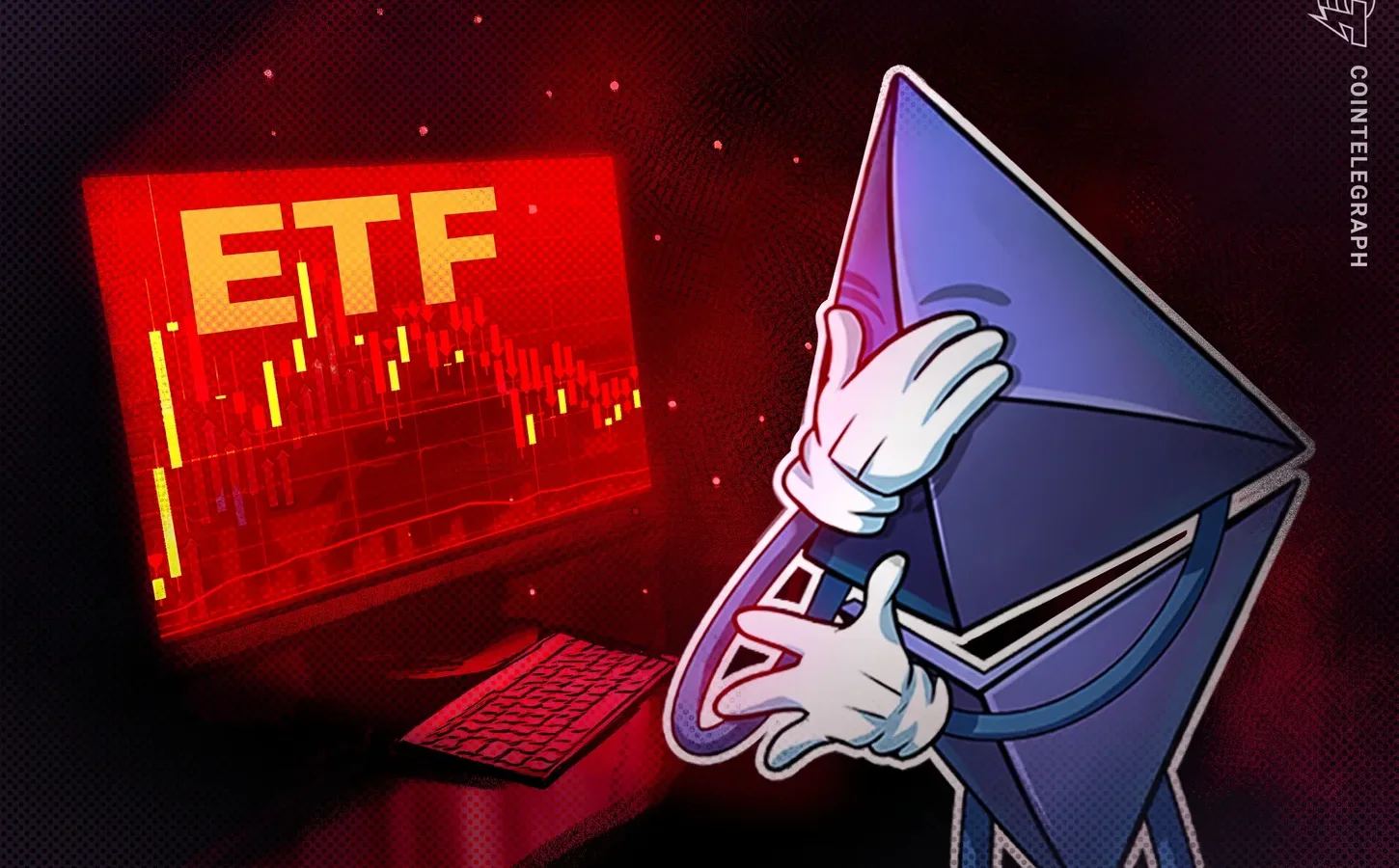
The $1 Billion Exodus: Why Ether ETFs are Bleeding While Bitcoin Holds $83,000
فرار یک میلیارد دلاری از اتریوم؛ چرا بازار کریپتو در اکتبر ۲۰۲۶ دوپاره شده است؟
Institutional investors have pulled over $1 billion from Ether ETFs this October, marking a historic shift in sentiment. While Bitcoin remains resilient near $83,468, the 'digital oil' is facing a crisis of confidence that every Iranian crypto holder needs to understand.
At time of publishing
USD
266,900
Toman
Gold 18K
26.71M
Toman / gram
Bitcoin
$83,468
US Dollar
Tether
264,490
Toman
The Great Institutional Divergence
For months, the crypto market moved in lockstep, but October 2026 has introduced a startling divergence. While Bitcoin (BTC) continues to hover around the $83,468 mark, showing remarkable resilience, its younger sibling, Ethereum, is facing a brutal reality check. According to the latest market data, U.S. spot Ether ETFs have shed a staggering $1.08 billion so far this month. This represents the largest monthly outflow since these financial products were launched, signaling that the 'smart money' on Wall Street is currently re-evaluating the value proposition of the world's second-largest cryptocurrency.
This exodus isn't happening in a vacuum. While Bitcoin has successfully branded itself as 'digital gold'—a safe haven during geopolitical uncertainty—Ethereum is often viewed as 'digital oil' or the infrastructure for the decentralized web. When global economic conditions tighten, investors tend to dump the infrastructure plays first and cling to the stores of value. With the UK government reporting a massive £24.5 billion borrowing deficit and record-high debt interest payments of £10.9 billion in September alone, the global appetite for risk is being squeezed by the reality of persistent inflation and high interest rates.

Why Ethereum is Losing the Popularity Contest
Beyond the macroeconomics, Ethereum is facing stiff competition from within the crypto ecosystem. While ETH struggles with outflows, Solana is preparing for its 'Alpenglow' network overhaul, aiming for 150-millisecond finality. This technological arms race makes Ethereum's slower, more expensive upgrades look less appealing to institutional giants who want efficiency. The market is effectively saying that if Ethereum isn't the fastest or the cheapest, and it isn't the 'safest' (like Bitcoin), then what exactly is its role in a high-interest-rate world?
The pressure on Ether is further compounded by the lack of 'staking' rewards within the current U.S. ETF structures. Institutional buyers are realizing they are holding a productive asset in a non-productive wrapper, missing out on the 3-4% yield they could get by holding the coins directly. In a world where UK gilts and US Treasuries are offering significant 'risk-free' returns, a non-yielding Ether ETF becomes a hard sell for a portfolio manager in London or New York.

The Iranian Perspective: Hedging the Hedge
For the Iranian investor, these global shifts have immediate local consequences. Today, the USD/IRR rate in the open market has climbed to 266,900 Toman, a 1.2% increase in just 24 hours. When the Toman loses value, Iranians traditionally rush to USDT (Tether) and Bitcoin. However, the current weakness in Ethereum suggests that those using ETH as a long-term store of value might be underperforming compared to those holding Bitcoin or gold. Gold 18k has risen to 26.7 million Toman per gram, tracking both the global gold price of $4,126 and the local currency's decline.
It is also worth noting the local industrial climate. Official claims regarding the incident at the Iranian Aluminum Company (IRALCO) in Arak suggest 'voltage fluctuations' rather than sabotage, but such events remind investors of the fragility of local infrastructure. In this environment, the choice between different crypto assets matters more than ever. If the global trend is 'Bitcoin-only' for institutions, Iranian retail traders should be cautious about 'buying the dip' in altcoins like Ethereum without understanding that the institutional floor has significantly weakened this month. Diversification remains key, but understanding which asset serves as the true 'inflation hedge' is the difference between preserving wealth and watching it erode.
Concept Diagram
Watch
Why JP Morgan Is Finally Bullish on Bitcoin
Yahoo Finance
Frequently Asked Questions
چرا با وجود ثبات بیتکوین، سرمایه از اتریوم خارج میشود؟
آپدیت Alpenglow سولانا چه تاثیری بر بازار دارد؟
آیا افزایش قیمت دلار در ایران به دلیل ریزش اتریوم است؟
Understanding the Divergence: Bitcoin vs. Ethereum in Institutional Investment
The recent market activity, where Bitcoin maintains strong price levels while Ethereum (Ether) Exchange-Traded Funds (ETFs) experience significant outflows, highlights a crucial concept in cryptocurrency markets: the divergent investment narratives and regulatory perceptions of these two leading digital assets. While both are foundational to the crypto ecosystem, institutional investors often view them through distinct lenses, influencing their willingness to allocate capital.
Bitcoin's enduring appeal to institutional investors largely stems from its narrative as "digital gold" – a scarce, decentralized store of value analogous to traditional safe-haven assets. Its fixed supply and first-mover advantage have cemented its status, and crucially, regulatory bodies in key markets like the U.S. have generally categorized Bitcoin as a commodity, paving a clearer path for the approval of spot Bitcoin ETFs. This regulatory clarity and the established store-of-value thesis provide a relatively more predictable investment environment for large-scale financial institutions.
Ethereum, on the other hand, powers the vast ecosystem of decentralized applications (dApps), smart contracts, and NFTs, positioning it as the "world computer" or "programmable money." While its utility is immense and growing, its regulatory classification remains more ambiguous. There's ongoing debate, particularly from the U.S. Securities and Exchange Commission (SEC), whether Ether should be classified as a security rather than a commodity. This regulatory uncertainty creates a higher hurdle for the approval and adoption of spot Ether ETFs, as investors and fund managers face greater potential legal and compliance risks.
This fundamental difference in investment narrative and, critically, regulatory status, explains much of the observed divergence. Institutional investors, prioritizing risk management and regulatory compliance, may be more hesitant to commit to Ether ETFs until there is greater clarity on its classification. This caution, coupled with Bitcoin's established position and clearer regulatory path, can lead to scenarios where one asset's institutional investment vehicles thrive while the other's face significant headwinds and outflows, even amidst broader market interest in cryptocurrencies.