
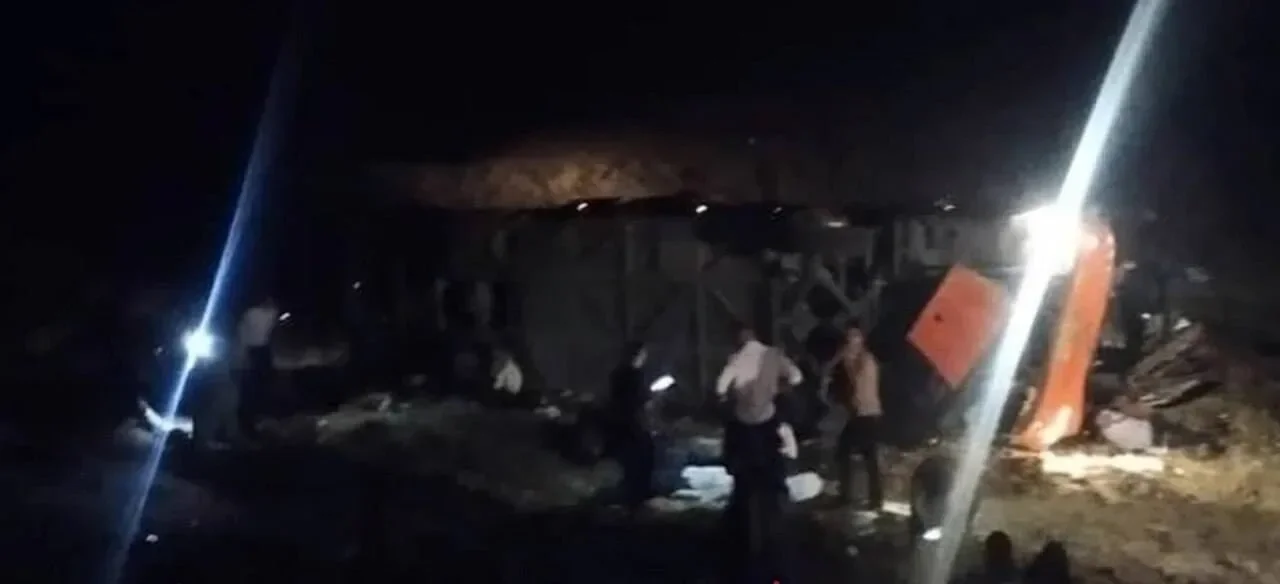
Fatal Bus Crash in Ilam Claims 12 Lives as Tehran Rejects Trump’s ‘Fabricated’ Historical Narratives
تراژدی مرگبار اتوبوس در ایلام و پاسخ تند تهران به ادعاهای تاریخی ترامپ
A tragic bus accident involving oil sector employees in western Iran has left 12 dead, while the Foreign Ministry engages in a sharp rhetorical battle with Donald Trump over the origins of regional instability.
At time of publishing
USD
268,800
Toman
Gold 18K
24.78M
Toman / gram
Bitcoin
$64,489
US Dollar
Tether
270,732
Toman
Industrial Tragedy in Ilam: 12 Oil Workers Killed
A devastating bus crash in the Abdanan County of Ilam Province has claimed the lives of 12 employees of a local oil company, with another 16 individuals sustaining various degrees of injury. The vehicle, which was transporting workers to their site, reportedly overturned on one of the province's notoriously difficult roads. Local officials have confirmed that the scale of the accident has placed significant strain on regional emergency services, highlighting the persistent dangers faced by industrial workers commuting in Iran’s rugged western corridors. This incident is not merely a traffic statistic; it underscores a deepening concern regarding the aging transport infrastructure and the safety protocols governing the movement of personnel in the vital energy sector.
For the Iranian public, such tragedies serve as a grim reminder of the high human cost associated with the country's oil and gas operations, which often take place in remote, underdeveloped regions. As the families of the victims mourn, there are growing calls for a thorough investigation into whether the accident was caused by mechanical failure, driver fatigue, or the poor condition of the roads in Ilam. In a broader economic sense, these events dampen morale within the industrial workforce and highlight the urgent need for infrastructure investment, which has been hampered by years of economic isolation and budget misallocation.
---
Tehran Rebuffs Trump: The Battle Over Historical Memory
On the diplomatic front, Iranian Foreign Ministry spokesperson Esmaeil Baqaei has issued a stinging rebuke to recent claims made by US President Donald Trump. Trump suggested that the current state of conflict in the Middle East is a direct legacy of the 1979 Islamic Revolution, effectively blaming Iran for decades of regional instability. Baqaei dismissed these assertions as a "deceptive narrative" and a "fabrication" designed to help Washington evade responsibility for its own history of interventionism. He specifically labeled the US approach as a "war of choice," suggesting that the primary driver of aggression in the region has been American policy rather than Iranian domestic shifts.
This exchange is significant because it sets the tone for the upcoming diplomatic cycle as world leaders prepare for major summits in Asia. By framing the conflict as a historical "war of choice" by the United States, Tehran is attempting to preemptively challenge the legitimacy of any further sanctions or military posturing from the Trump administration. For the average Iranian, this rhetorical escalation is closely watched for its impact on market sentiment; however, the Rial has remained remarkably stable today, with the USD sell rate holding firm at 268,800 Toman. The lack of immediate currency volatility suggests that traders have already priced in a high level of verbal hostility between the two nations.
---
A Global Legal Precedent: The ICJ and the Concept of Genocide
The international legal community is holding its breath as the World’s Top Court prepares to rule on whether Myanmar committed genocide against its Rohingya minority. This case is of paramount importance because the International Court of Justice (ICJ) has never before found a state guilty of the "gravest of all international crimes." A ruling of this nature would not only redefine the accountability of sovereign states but also set a critical benchmark for other ongoing international disputes, including the high-profile case against Israel regarding its actions in Gaza. The judgment is expected to resonate far beyond the borders of Myanmar, influencing how international law is applied in the 21st century.
For global markets and geopolitical analysts, the ICJ's decision could trigger a new wave of sanctions and shift trade alliances, particularly in Southeast Asia where countries like Myanmar are central to regional security discussions. If the court establishes a precedent for state-level genocide, it could embolden legal challenges against other nations, creating a more litigious and perhaps more accountable global order. This comes at a time when Southeast Asian nations are already pivoting toward renewable energy to escape the volatility of Middle Eastern oil routes, suggesting a broader regional movement toward strategic independence and legal scrutiny.
---
Market Stability Amidst Regional Tension
Despite the tragic news from Ilam and the heated diplomatic exchanges, Iran's domestic markets have shown surprising resilience this Sunday, November 15, 2026. The US Dollar remained unchanged at 268,800 Toman, reflecting a state of cautious equilibrium. Gold, however, saw a marginal decline, with 18k gold dropping from 24,798,005 to 24,781,845 Toman per gram, a decrease of 0.1%. This minor fluctuation in gold prices, contrasted with the stability of the currency, suggests that while there is no immediate panic, investors are slightly adjusting their hedges in response to global price movements rather than local political shocks.
In the cryptocurrency space, Bitcoin continues to trade around the $64,489 mark, providing a digital alternative for those wary of traditional fiat stability. However, the sector was not without its own drama, as Kava Lend reported a loss of approximately $3.8 million due to a hack, causing its native token to plummet. For Iranian investors who increasingly use stablecoins like USDT (currently at 270,732 Toman) to preserve capital, these security breaches serve as a reminder that the digital frontier carries its own set of systemic risks, separate from the geopolitical tensions of the physical world.
Frequently Asked Questions
Why is the Ilam bus crash being linked to industrial safety?
What was Esmaeil Baqaei's specific response to Donald Trump?
How did the Iranian gold market react today?
What is the significance of the ICJ ruling on Myanmar?
Understanding Iran’s Dual Exchange Rate System and the USD/IRR Black Market
Iran’s foreign‑exchange market is split into an official rate set by the Central Bank and a parallel "black‑market" rate that reflects real supply‑and‑demand conditions. The official rate is used for government transactions, essential imports, and some contracts, but it is often artificially high or low because the state controls the amount of foreign currency that can be bought or sold. In contrast, the black‑market rate—commonly quoted as the USD/IRR price you see in news headlines—emerges from private traders, smugglers, and everyday Iranians who need dollars for travel, savings, or purchasing goods that are unavailable domestically.
The dual system creates several economic distortions. First, it encourages arbitrage: businesses that can access the official rate buy dollars cheaply and sell them on the black market for a profit, draining foreign reserves. Second, it fuels inflation because imported goods priced at the higher black‑market rate cost more in rials, pushing up consumer prices. Finally, it erodes confidence in the national currency, prompting households to hoard dollars or switch to alternative stores of value, which further weakens the rial.
Iran has tried to narrow the gap by periodically adjusting the official rate, imposing stricter capital controls, or allowing limited currency‑exchange windows. However, sanctions, reduced oil revenues, and persistent macro‑economic imbalances keep the black‑market premium high. Understanding the mechanics of this dual exchange‑rate regime helps explain why headlines about the USD/IRR price matter not just for traders but for anyone interested in Iran’s broader economic stability.
For a deeper dive, you can explore the history of Iran’s exchange‑rate policies, the impact of sanctions on its currency, and the role of informal markets in shaping everyday economic reality.
Topics
Related Articles

