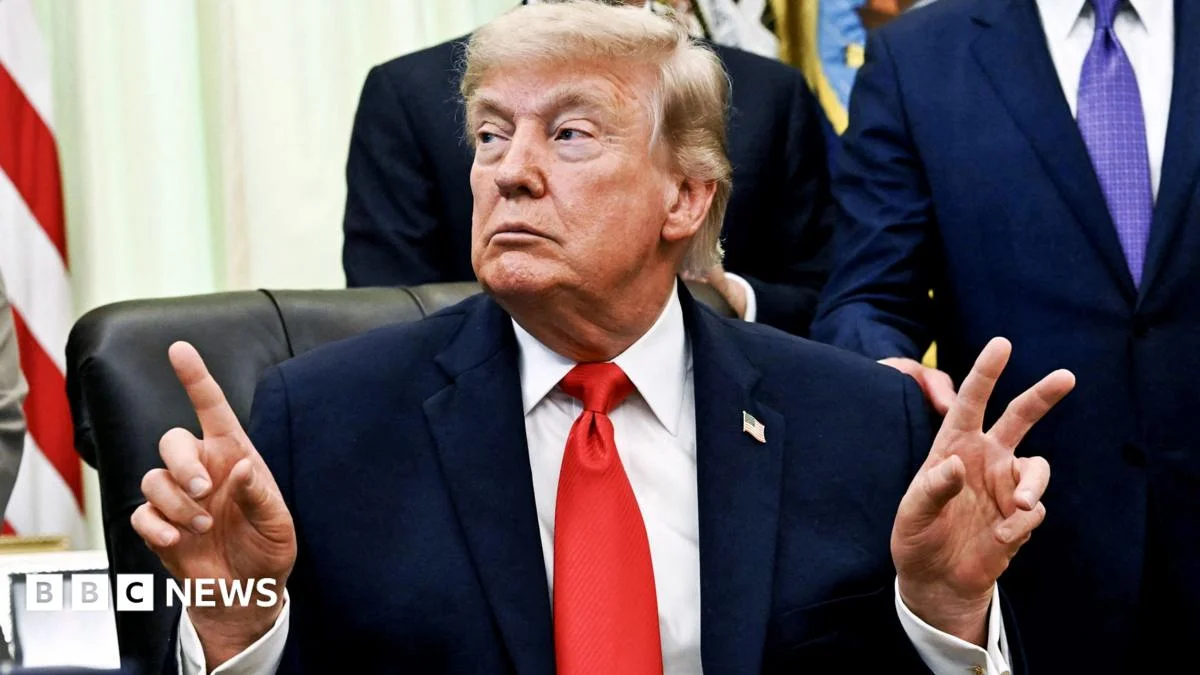
The Billion-Dollar Presidential Wallet: What Trump’s Crypto Gains Mean for Your Portfolio
کیف پول میلیارد دلاری رئیسجمهور؛ سود ۱ میلیارد دلاری ترامپ از کریپتو چه پیامی برای بازار دارد؟
Donald Trump has reportedly earned over $1 billion from crypto in just one year, marking a massive shift in how world leaders interact with digital assets. While Bitcoin faces a 'bearish storm' and ETF outflows, this news highlights a growing divide between political sentiment and market reality.
At time of publishing
USD
175,050
Toman
Gold 18K
16.86M
Toman / gram
Bitcoin
$58,803
US Dollar
Tether
175,162
Toman
The Presidential Pivot to Digital Gold
In a move that would have been unthinkable just a few years ago, recent financial disclosures reveal that Donald Trump has earned over $1 billion from cryptocurrency-related ventures during his first year back in office. This figure, as reported by the BBC, actually outpaces his traditional earnings from real estate and branded merchandise. For the average investor, this isn't just a celebrity gossip story; it represents a fundamental shift in the 'legitimacy' of digital assets. When the leader of the world's largest economy is more profitable in the digital realm than in physical skyscrapers, the 'fad' argument for crypto effectively dies.
However, there is a sharp irony at play. While the political class is profiting, the retail market is feeling the squeeze. Bitcoin is currently testing a critical support level at $57,832, caught in what analysts call a 'bearish storm.' The contrast is stark: the high-level adoption and 'Trump-themed' crypto success are happening simultaneously with the worst month for spot Bitcoin ETFs since their debut. In June 2026, these ETFs shed $4.5 billion as capital rotated toward other opportunities, including the high-profile SpaceX IPO. This tells us that institutional money is fickle; it moves where the immediate growth is, leaving retail holders to weather the volatility.

Why the Market is Ignoring the Good News
You might ask: if a US President is making billions in crypto, why isn't the price of Bitcoin skyrocketing? The answer lies in the 'rotation of capital.' Market data shows that investors are currently distracted by massive shifts in the tech and energy sectors. For instance, US companies are betting $50 billion on coal and gas power to fuel the AI data center boom. This massive hunger for liquidity in traditional sectors means less 'spare change' for speculative assets like Bitcoin. Even with high-level political backing, crypto must compete with the tangible reality of the AI-driven energy crisis.
Furthermore, the 'institutional shield' that many hoped ETFs would provide is proving to be thinner than expected. The theory was that big banks and funds would stabilize the market, but as we saw in June, they are often the first to exit when macroeconomic uncertainty hits. This 'paper-handed' behavior by institutions means that Bitcoin's price action remains volatile, despite the growing list of high-profile backers. For an investor in Tehran, this means that watching global 'hype' isn't enough; you must watch the actual flow of dollars and the health of the US tech sector to understand where crypto is headed.
Security, Scams, and the Iranian Reality
While we celebrate or analyze presidential profits, the darker side of the digital frontier remains a massive risk. Recent reports of a $400 million Ponzi scheme involving Goliath Ventures and a $29 million illegal forex ring in Shanghai serve as a grim reminder. Even in highly regulated markets like Australia, security is not guaranteed; recently, employees at EY were caught allegedly accessing the private bank details of Prime Minister Anthony Albanese. This global trend of digital vulnerability is a crucial lesson for the Iranian user: as the value of your digital footprint grows, so does the target on your back.
In the local Iranian market, we are seeing a decoupling of sorts. While Bitcoin struggles globally, the price of USD in Tehran has risen 1.4% to 175,050 Toman, and the Emami gold coin has jumped 1.7% to 174,500,000 Toman. This local 'bull run' is driven more by currency devaluation and geopolitical hedging than by global crypto sentiment. For the Arzbin reader, the strategy remains clear: use stablecoins like USDT (currently at 175,162 Toman) as a bridge to preserve value, but don't let 'presidential hype' blind you to the very real risks of market manipulation and security breaches that are currently plaguing the global scene.

Frequently Asked Questions
Why is Bitcoin falling if Donald Trump made $1 billion from it?
What does the 'rotation of capital' mean for my portfolio?
How does the rise in USD/IRR relate to global crypto trends?
Is it safe to follow 'celebrity' or 'political' crypto trends?
The Institutionalization of Cryptocurrency
The recent headlines about high-profile figures like Donald Trump holding significant crypto assets, coupled with discussions around Bitcoin ETF flows and institutional adoption, point to a pivotal shift in the cryptocurrency landscape: its institutionalization. This term refers to the increasing involvement of traditional financial institutions—such as banks, asset managers, hedge funds, and large corporations—in the cryptocurrency market. Historically dominated by retail investors and tech enthusiasts, the crypto space is now attracting the attention and capital of established financial players, fundamentally altering its dynamics and market structure.
This institutional embrace is driven by several factors. As cryptocurrencies, particularly Bitcoin, gain legitimacy and a longer track record, they are increasingly viewed as a viable asset class for diversification and potential returns. The introduction of regulated investment vehicles, like Bitcoin Exchange-Traded Funds (ETFs), has significantly lowered the barrier to entry for institutions, allowing them to gain exposure to crypto without the complexities of direct ownership, custody, and regulatory compliance. These ETFs provide a familiar and regulated framework, making crypto more accessible to institutional portfolios that operate under strict mandates.
The implications of institutionalization are profound. On one hand, it brings substantial capital inflows, increased liquidity, and enhanced market maturity. Large institutional investments can provide greater stability and reduce the extreme volatility often associated with retail-driven markets. It also lends credibility to the asset class, pushing it further into the mainstream financial system. However, it also introduces new considerations, such as the potential for greater correlation with traditional markets, the influence of large institutional trades on price movements (like the mentioned Bitcoin ETF outflows), and the need for robust regulatory frameworks to manage systemic risks.
Ultimately, the institutionalization of cryptocurrency signifies its evolution from a niche, speculative asset to a more integrated component of the global financial ecosystem. While retail investors continue to play a vital role, the growing presence of institutional money underscores a broader acceptance and maturation of the crypto market, paving the way for new financial products, services, and a more interconnected digital economy.