SK Hynix Smashes Records with $26.5bn US Debut as Tehran Succession Mystery Deepens
رکوردشکنی ۲۶ میلیارد دلاری اسکی هاینیکس در والاستریت؛ ابهام در جانشینی و غیبت مجتبی خامنهای
South Korea's SK Hynix has completed the largest foreign IPO in US history, fueled by insatiable AI demand. Meanwhile, the continued absence of Mojtaba Khamenei from public life raises questions about Iran's leadership transition.
At time of publishing
USD
178,450
Toman
Gold 18K
17.59M
Toman / gram
Bitcoin
$63,862
US Dollar
Tether
178,500
Toman
SK Hynix Rewrites Wall Street History with AI-Fueled IPO
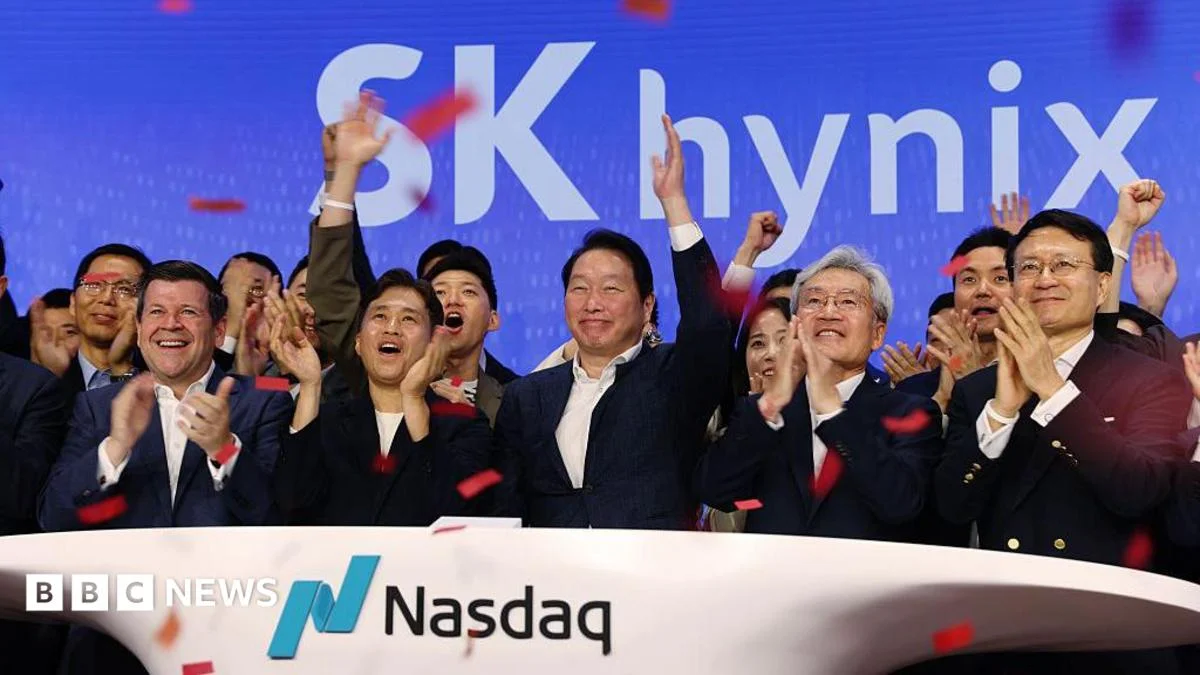
In a historic moment for the global semiconductor industry, South Korean chip giant SK Hynix successfully raised $26.5 billion in its Nasdaq debut this Friday. This massive listing officially surpasses Alibaba’s 2014 record to become the largest-ever foreign IPO on a U.S. exchange. The market's appetite for the stock was overwhelming, with shares surging as much as 17% during the first hours of trading. This frenzy is driven almost entirely by the company's critical role as the primary supplier of High Bandwidth Memory (HBM) chips for Nvidia’s AI processors. Investors are betting heavily that the artificial intelligence revolution is only in its early stages, and SK Hynix is positioned as an indispensable gatekeeper of the hardware required to power it.
However, the listing comes with significant geopolitical strings attached. While Wall Street celebrates the liquidity and growth potential, U.S. policymakers are already increasing pressure on the South Korean firm to diversify its manufacturing base. Following the IPO, reports suggest that the U.S. Department of Commerce is urging SK Hynix to commit to building new advanced fabrication plants (fabs) on American soil to secure the domestic supply chain. This reflects a broader trend where massive capital raises are no longer just about corporate growth, but are deeply intertwined with the technological arms race between the West and its competitors. For the average investor, this IPO signals that the AI-driven market cycle still has significant momentum, even as traditional sectors face headwinds.
The Silent Succession: Mojtaba Khamenei’s Absence Rattles Tehran
The political landscape in Tehran is currently defined by a conspicuous void. Mojtaba Khamenei, long considered a frontrunner to succeed his father, has not been seen in public even during the week-long funeral ceremonies for the late leader. While official narratives are scarce, reports indicate he was wounded in the recent US-Israeli air strikes that targeted high-level meetings. His total disappearance from the public eye—even at a time of national mourning—has sparked intense debate among analysts. Some suggest his injuries may be more severe than initially admitted, while others believe his absence signals a fundamental shift in the role of the Supreme Leader's office, possibly moving toward a more collective leadership model to ensure regime survival amidst unprecedented external pressure.
This uncertainty is having a direct impact on domestic sentiment and market stability within Iran. For decades, the clarity of succession was a pillar of the Islamic Republic's internal security strategy. Now, with the primary candidate absent and the country reeling from military strikes, a sense of a power vacuum is emerging. This political instability often translates into currency volatility, as citizens look for safe havens like gold and hard currency. The lack of transparent communication from state institutions regarding the health or whereabouts of such a pivotal figure only serves to fuel the rumor mill, further eroding public trust during one of the most sensitive transitions in the country's history.
Trump’s Hormuz Gambit: Negotiation Hints Amidst Regional Fire
Despite the recent exchange of fire over the Strait of Hormuz, former President Donald Trump has hinted at the possibility of a new round of negotiations with Tehran. This development comes at a moment of extreme tension, where many feared a full-scale regional war was imminent. Trump’s characteristic approach—combining military pressure with the offer of a 'grand deal'—appears to be back in play. By signaling an openness to talk after a show of force, the U.S. administration is attempting to force the Iranian leadership into a corner where the choice is between total economic and military collapse or a highly restrictive new agreement.
For global markets, these hints of diplomacy provide a much-needed, albeit fragile, sense of relief. The Strait of Hormuz remains the world's most critical oil chokepoint, and any prolonged disruption there would send global energy prices into a tailspin. However, the Iranian side has yet to officially respond to these overtures. The current leadership in Tehran is navigating a complex internal crisis, and engaging with a Trump-led administration may be seen as a sign of weakness by hardline factions. Nevertheless, the mere mention of negotiations has placed a temporary floor under the market, preventing a more catastrophic spike in risk premiums across the Middle East.
Market Correction: Toman and Gold Retreat as Global Pressures Shift
Turning to the local markets, we have observed a significant correction in the value of the Iranian Toman and gold prices over the last 24 hours. The USD/IRR exchange rate moved from 181,100 down to 178,450, representing a 1.5% appreciation for the Toman. Similarly, 18k gold followed this downward trend, falling from 17,874,786 to 17,590,839 Toman per gram, a decrease of 1.6%. These movements suggest that some of the immediate panic following the regional strikes has subsided, or perhaps that the central bank has intervened heavily to prevent a total currency collapse during the leadership transition.
While the Toman showed strength today, the Emami coin remained stagnant at 181,500,000 Toman, showing a 0.0% change. This divergence suggests that while the spot market for currency and gold bullion is adjusting to new data, the coin market—often driven by speculative long-term bets—remains cautious. Investors are likely waiting for more concrete news regarding the succession in Tehran and the potential for the aforementioned negotiations before making significant moves. In the crypto space, Bitcoin continues to trade around the $63,862 mark, providing a relatively stable alternative for those looking to hedge against the ongoing domestic political uncertainty.
Frequently Asked Questions
Why is the SK Hynix IPO so significant for the tech market?
What are the theories behind Mojtaba Khamenei's public absence?
How did the Iranian Toman react to the recent geopolitical tension?
Understanding Geopolitical Risk in a Connected World
Geopolitical risk refers to the potential for political events, conflicts, or instability in one region to have far-reaching economic and financial consequences globally. It encompasses a broad spectrum of issues, from interstate wars and regional conflicts to political transitions, trade disputes, and policy shifts by major powers. Unlike typical market risks, geopolitical risks are often unpredictable and can trigger sudden shifts in investor confidence, commodity prices, and supply chains, making them a critical factor for businesses and governments worldwide.
The headline vividly illustrates the dual nature of geopolitical risk. The "Tehran Succession Mystery" and "Strait of Hormuz tension" represent significant sources of such risk. A contested succession in a key Middle Eastern power like Iran could lead to internal instability or shifts in foreign policy, potentially impacting global energy markets due to Iran's role and the strategic importance of the Strait of Hormuz, a vital chokepoint for a substantial portion of the world's oil supply. Any disruption there directly threatens global trade and energy security.
Economically, geopolitical risks manifest in various ways. The "Toman exchange rate" fluctuations, often driven by sanctions and political uncertainty, exemplify how national currencies can be destabilized. The prospect of "Trump Iran negotiations" or their breakdown further adds to this uncertainty, affecting investment decisions and trade relations. Even high-tech sectors like the "AI semiconductor market," represented by companies like SK Hynix and Nvidia, are not immune; disruptions in global supply chains, shifts in international trade policies, or reduced investor confidence due to regional instability can significantly impact their operations and market valuations.
Understanding geopolitical risk is crucial for investors, policymakers, and businesses alike. It necessitates a keen awareness of global political dynamics and their potential ripple effects across diverse markets, from emerging economies to advanced technological sectors. Proactive assessment and mitigation strategies are essential to navigate an increasingly interconnected world where political events in one corner can swiftly reshape economic landscapes globally.