Trump Admits Iran War Cost Republicans the Midterms as Democrats Seize US Congress
اعتراف ترامپ به شکست در برابر «موج آبی»؛ جنگ ایران پاشنه آشیل جمهوریخواهان شد
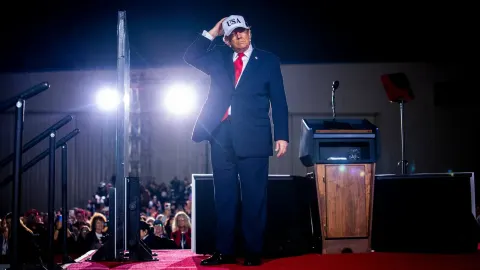
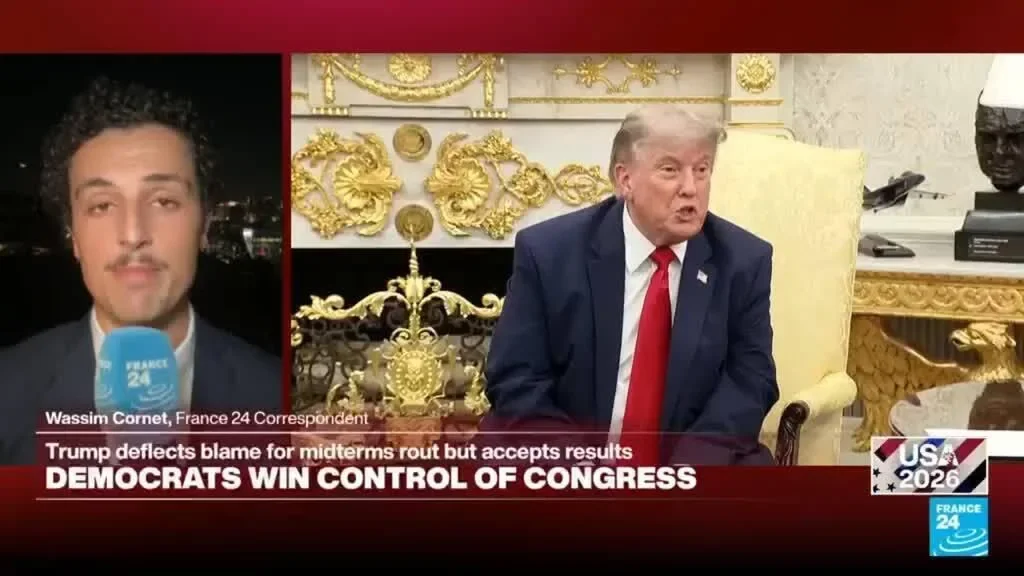
A historic 'Blue Wave' has swept the United States, giving Democrats control of both the House and Senate. President Trump has acknowledged that the ongoing conflict with Iran played a pivotal role in the Republican defeat, while global gold prices soar past $4,000.
At time of publishing
USD
269,000
Toman
Gold 18K
26.08M
Toman / gram
Bitcoin
$78,526
US Dollar
Tether
269,199
Toman
The Blue Wave Sweeps Washington
In a historic shift of power that will redefine the final two years of the Trump presidency, the Democratic Party has secured a decisive victory in the 2026 US midterm elections. By flipping key Senate seats in traditionally Republican strongholds such as Texas, North Carolina, South Carolina, and Iowa, the Democrats have effectively dismantled the Republican legislative monopoly. President Donald Trump, speaking from the White House, offered rare praise for his rivals' campaign tactics while simultaneously lashing out at critics on social media. In a characteristically blunt post, he targeted Democratic strategists but ultimately conceded that the political landscape had shifted beneath his feet.
What makes this defeat particularly significant is Trump’s own admission regarding the cause. In an interview with Fox News, the President acknowledged that the unpopularity of the ongoing military tensions and conflict with Iran played a major role in alienating voters. This admission marks a departure from his usual rhetoric, suggesting that the administration recognizes the domestic political cost of its 'maximum pressure' and kinetic operations in the Middle East. For the American electorate, the combination of rising costs of living—exacerbated by trade tariffs—and the shadow of an open-ended war proved too much to ignore.
Global Markets and the 'Blue Trade'
Financial markets have reacted with a mixture of caution and opportunistic repositioning to the news of a divided government. As the 'Blue Wave' solidified, investors began what analysts are calling the 'Blue Trade,' characterized by a massive surge in renewable energy stocks across Europe and Asia. Investors are betting that a Democratic-controlled Congress will pivot away from Trump’s hostility toward green energy and toward a more regulated, subsidy-heavy environmental framework. Conversely, the AI sector, which has dominated market narratives for years, saw a significant sell-off as uncertainty grew over potential new regulatory hurdles and a shift in federal compute capacity expansion plans.
In the commodities and currency space, the impact has been even more pronounced. Gold has reached a staggering milestone, trading at $4,043.00 per ounce, as investors flee to safe-haven assets amid the geopolitical uncertainty of the US-Iran conflict. In the local Iranian market, we see a complex divergence: while the USD/IRR pair saw a slight correction, moving from 271,400 to 269,000 Toman (-0.9%), the price of gold in Iran followed the global trend. The 18k gold price rose from 25,451,313 to 26,079,228 Toman per gram (+2.5%), and the Emami coin climbed to 264,000,000 Toman (+1.0%), reflecting the intense demand for value preservation among Iranian citizens.
Geopolitical Deadlock and the Iran Strategy
The most immediate consequence of this election for the Middle East is the looming legislative gridlock in Washington. Starting January 3, the new Democratic-led Congress will possess the authority to subpoena documents, call witnesses, and, most importantly, block funding for military operations. This provides a significant check on the Trump administration’s ability to escalate the war with Iran. Analysts suggest that the Democrats will likely use their newfound power to investigate the origins of the current maritime conflict and the administration's broader strategy, potentially forcing a diplomatic pivot that was previously off the table.
However, this transition period remains volatile. While the 'Blue Wave' suggests a mandate for de-escalation, the lame-duck period between now and January could see the current administration attempt to solidify its gains or double down on its regional objectives before the new Congress is sworn in. For the Iranian economy, this means a period of high sensitivity; while a Democratic Congress might eventually lead to eased sanctions or a return to negotiations, the immediate reality is one of continued military tension and market volatility. The slight strengthening of the Toman today suggests a cautious optimism that the 'war party' in Washington has been rebuked, but the surge in gold prices proves that the fear of a broader conflict has not yet subsided.
Historical Echoes and the Information War
Beyond the immediate headlines of the election, the global discourse on information and dehumanization has taken a scholarly turn. In London, the Wiener Holocaust Library has opened an archive examining the Dreyfus affair of 1894—the world’s first 'viral' antisemitism scandal. This historical reflection serves as a poignant reminder of how rapidly misinformation and political polarization can spiral out of control, a theme that resonated deeply during the 2026 midterms. The archive highlights how the lifting of censorship laws and the speed of the printing press in the 19th century mirror today’s social media environment, where political identities are forged through conflict and 'othering.'

This historical context is relevant today as we witness the 'viral' nature of modern political campaigns and the way foreign policy—specifically the war with Iran—is used as a wedge issue. Just as the Dreyfus affair divided France for a generation, the current US political divide over the Middle East is creating long-lasting fractures in the Western alliance. As the Democrats prepare to take power, they face the challenge of not just managing a war, but also healing a domestic information ecosystem that has become increasingly fragmented and hostile. For the global observer, the lesson of the Dreyfus archive is clear: once the seeds of dehumanization are sown in the pursuit of political power, they are incredibly difficult to uproot.
Watch
Midterms: Trump acknowledges role of Iran war, congratulates Dems • FRANCE 24 English
FRANCE 24 English
Frequently Asked Questions
چرا پیروزی دموکراتها در کنگره برای ایران اهمیت دارد؟
علت جهش قیمت طلا به بالای ۴۰۰۰ دلار چیست؟
واکنش بازار ارز ایران به نتایج انتخابات آمریکا چه بود؟
Understanding Geopolitical Risk: Its Profound Impact on Elections and Markets
Geopolitical risk refers to the potential for political instability, conflicts, or international tensions to disrupt global affairs, with significant economic, social, and environmental consequences across borders. While a constant undercurrent in international relations, its prominence surges during periods of heightened tension, such as the specter of a major conflict like the “Iran War” mentioned in the headline. These risks are not confined to specific regions; they can ripple globally, affecting everything from trade routes to investor sentiment.
One of the most immediate and tangible impacts of geopolitical risk is on domestic politics and electoral outcomes. As suggested by the headline, a costly or unpopular foreign conflict can profoundly shift public opinion, turning voters against the incumbent party or administration. This phenomenon can lead to significant political realignments, such as a “Democratic Blue Wave” in midterm elections, as citizens express their dissatisfaction at the ballot box. Understanding this dynamic is crucial for grasping how international events can directly shape national leadership and policy direction.
Financial markets are particularly sensitive to geopolitical shocks. During times of uncertainty, investors often seek “safe-haven assets” like gold, driving up its price (potentially towards figures like “Gold Price 4000 USD”). Currency markets also react sharply; for instance, the “USD IRR Market” would experience extreme volatility during a conflict involving Iran, reflecting heightened risk premiums and capital flight. Broader equity markets tend to become more volatile, with sectors like defense potentially seeing gains, while others face headwinds.
Beyond traditional assets, the landscape of geopolitical risk now also influences emerging markets and digital assets. Energy security concerns stemming from conflicts can impact “Renewable Energy Stocks,” either by accelerating investment in alternatives or by disrupting supply chains. Even cryptocurrencies like “Bitcoin,” initially touted as a hedge against traditional financial systems, can experience complex reactions, sometimes acting as a safe haven, other times mirroring broader market risk aversion. The interconnectedness of modern finance means that geopolitical tremors are felt across virtually all asset classes.
Topics
Related Articles