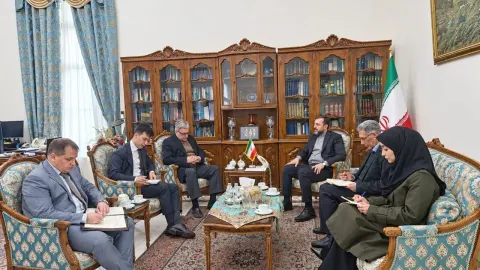
Justice Speaks: Judge Praised in Brand Sentencing as Toman Gains on Nuclear De-escalation Hopes
پیام روشن قاضی پرونده راسل برند؛ عقبنشینی دلار در پی سیگنالهای هستهای تهران
A UK judge receives widespread acclaim for dismantling rape myths in the Russell Brand sentencing, while the Iranian Toman strengthens by 2.4% as Tehran reaffirms its commitment to the Non-Proliferation Treaty despite internal hardline pressure.
At time of publishing
USD
257,900
Toman
Gold 18K
25.76M
Toman / gram
Bitcoin
$73,205
US Dollar
Tether
256,100
Toman
Judicial Clarity in the Russell Brand Sentencing
In a landmark moment for the British legal system, Mr. Justice Bennathan has been widely praised by the Criminal Bar Association and victims' rights campaigners for his "piercing clarity" during the sentencing of comedian Russell Brand. The judge took the rare and significant step of explicitly dispelling long-standing "rape myths" that had surfaced during the trial, providing a narrative that focused on the facts of the assault rather than the social standing or historical behavior of the victims. By addressing the role of "enablers"—those who witnessed or facilitated Brand’s behavior over the years—the judge has set a new precedent for how the judiciary handles cases involving systemic abuse of power in the entertainment industry.
This development is more than just a celebrity news story; it represents a fundamental shift in how Western legal systems are beginning to treat sexual violence in the post-Me-Too era. For observers in regions where judicial transparency is often criticized, the clarity of Justice Bennathan's remarks serves as a case study in how the law can be used to challenge social prejudices rather than reinforce them. Campaigners hope that this verdict will encourage more survivors to come forward, knowing that the court system is becoming increasingly sophisticated in identifying and rejecting defense strategies built on character assassination.

Iran’s Nuclear Tightrope and the Market’s Response
On the geopolitical front, Tehran is currently walking a delicate line between its international obligations and domestic political pressure. While hardliners within the Iranian establishment have increasingly called for a shift toward nuclear weaponization as a deterrent against recent external threats, the official government line remains one of adherence to the Non-Proliferation Treaty (NPT). This commitment, reaffirmed in recent hours, appears to have provided a much-needed cooling effect on the volatile Iranian currency market. The Toman, which had been under extreme pressure due to regional tensions, saw a notable recovery today as fears of an immediate escalation faded slightly.
In the currency markets, we observed a significant correction. The USD sell rate moved from 264,200 Toman down to 257,900 Toman, marking a 2.4% decrease in the dollar's value against the local currency. Similarly, the Emami gold coin saw its price drop from 259,000,000 Toman to 254,000,000 Toman, a 1.9% decline. These movements suggest that traders are pricing in a period of relative diplomatic stabilization, even if the underlying tensions remain unresolved. For the average Iranian citizen, this brief respite in the exchange rate offers a moment of psychological relief, though the long-term trajectory of the economy remains tethered to the outcome of ongoing nuclear negotiations and the potential for renewed sanctions relief.
The Silencing of Russia’s Bravest Voice
While markets react to nuclear rhetoric, the global state of press freedom took another hit as the lights finally went out at Novaya Gazeta, often described as Russia’s bravest independent newspaper. After more than 30 years of covering the dark corners of the Kremlin’s domestic and foreign policy, the publication has been effectively silenced by the Russian state's increasingly restrictive censorship laws. Journalists at the paper noted that the process of being silenced was not a sudden event but a long, agonizing campaign of legal harassment and physical threats that mirrors the broader crackdown on dissent across Eurasia.
The closure of Novaya Gazeta is a symbolic blow to the global community of independent journalists. It serves as a reminder of the rising cost of truth-telling in authoritarian environments. For readers in the Middle East and beyond, the fate of the paper is a cautionary tale about the fragility of civic institutions when they are not protected by a robust rule of law. As the paper’s archives go dark, the world loses a vital window into the internal mechanics of a superpower, leaving international observers to rely more heavily on state-sanctioned narratives that often obscure more than they reveal.

US Politics and the Shadow of Regional Conflict
In Washington, the political drama surrounding Pete Hegseth continues to intensify as the House of Representatives prepares for a crucial vote on his potential impeachment. Hegseth has remained defiant, characterizing the articles of impeachment as a "political spectacle" and defending his role in recent military operations against Iranian-backed groups and other regional actors. He argued that all actions taken under his watch were lawful operations ordered by the commander-in-chief and executed by American forces to protect national security. This internal US struggle is being watched closely in Tehran and other regional capitals, as the outcome could signal the future direction of American military posture in the Middle East.
This domestic political friction in the US adds another layer of uncertainty to the global economic outlook. If the impeachment process creates a vacuum in leadership or leads to a pivot in US foreign policy, the impact on global markets—particularly oil and gold—could be profound. For now, the "Hegseth affair" remains a primary driver of geopolitical risk premiums, keeping investors on edge even as individual currency markets like the Toman show temporary signs of strength. The intersection of US domestic policy and Middle Eastern security remains the most critical axis for global stability as we move toward the end of the year.
Frequently Asked Questions
چرا قیمت دلار در بازار تهران کاهش یافت؟
اهمیت حکم قاضی در پرونده راسل برند چیست؟
وضعیت استیضاح پیت هگست در آمریکا چگونه است؟
The Nuclear Non-Proliferation Treaty (NPT): Why It Matters for Iran and Global Markets
The Nuclear Non-Proliferation Treaty (NPT), opened for signature in 1968 and entered into force in 1970, is the cornerstone of the global regime that seeks to prevent the spread of nuclear weapons while promoting peaceful nuclear cooperation. It rests on three pillars: non‑proliferation (nuclear‑weapon states agree not to transfer weapons to others), disarmament (all parties commit to pursue nuclear disarmament), and the right to peaceful use of nuclear energy under International Atomic Energy Agency (IAEA) safeguards. By binding 191 states, the NPT creates a legal and diplomatic framework that shapes how countries negotiate nuclear deals, impose sanctions, and access nuclear technology.
Iran’s nuclear program has been a flashpoint because Tehran is a signatory to the NPT but is accused of pursuing enrichment activities that could breach its obligations. The 2015 Joint Comprehensive Plan of Action (JCPOA) was an interim agreement that linked sanctions relief to strict limits on Iran’s uranium enrichment, all verified by the IAEA. When the United States withdrew in 2018, many sanctions were re‑imposed, causing the Iranian rial (IRR) and its unofficial unit, the toman, to lose value sharply. The prospect of renewed diplomatic progress—often framed as “nuclear de‑escalation”—can lift market sentiment, prompting investors to bid up the toman and even local assets like the Emami coin.
Understanding the NPT is crucial for grasping why a single legal treaty can ripple through currency markets, media narratives, and even unrelated political events such as high‑profile court cases or media closures. The treaty’s verification mechanisms give the IAEA the authority to inspect facilities, and any perceived violation can trigger UN Security Council resolutions, which in turn affect oil prices, foreign exchange rates, and capital flows. Consequently, traders watch every diplomatic statement through the lens of NPT compliance, because a shift in Iran’s status can quickly translate into a swing in the USD/IRR price.
The NPT also illustrates the broader tension between sovereign rights and collective security. While the treaty guarantees the right to peaceful nuclear technology, it restricts the development of weapons‑grade material. This duality explains why some domestic actors—journalists, politicians, or even entertainers—might invoke the treaty in debates about national sovereignty, human rights, or economic policy. In short, the NPT is not just a diplomatic document; it is a market‑moving, geopolitically potent framework that links the fate of a nation’s nuclear ambitions to the everyday value of its currency.