Hormuz Stalemate Deepens as US Navy Chief Resigns; UK Warns of War-Driven Fiscal Crisis
بنبست در هرمز و استعفای ناگهانی وزیر دریایی آمریکا؛ هشدار لندن درباره هزینههای سنگین جنگ
The resignation of the US Navy Secretary and Iran's refusal to reopen the Strait of Hormuz have sent shockwaves through global markets, while the UK warns of a massive fiscal hole. Meanwhile, the EU has finally cleared a €90bn loan for Ukraine after months of delays.
At time of publishing
USD
154,050
Toman
Gold 18K
17.68M
Toman / gram
The Hormuz Deadlock and the Resignation of John Phelan
The geopolitical tension in the Persian Gulf has reached a fever pitch following the abrupt and immediate resignation of US Navy Secretary John Phelan. The Pentagon’s announcement came without a specified reason, but it coincides with a hardening stance from Tehran regarding the Strait of Hormuz. Iranian officials, including Parliament Speaker Mohammad Bagher Ghalibaf and Foreign Minister Abbas Araghchi, have made it clear that reopening the strategic waterway is "impossible" as long as there are flagrant breaches of the current ceasefire. Iran has recently seized two additional ships, moving them to its coastline, further complicating the maritime security landscape in a region already on edge.
This stalemate is not just a military concern but a rapidly expanding economic crisis. In London, the Treasury has warned that the ongoing conflict with Iran is likely to blow a massive hole in Chancellor Rachel Reeves’s carefully managed fiscal headroom. While the UK government initially undershot its annual borrowing target by £700 million, the costs associated with the Middle East escalation are expected to reverse these gains quickly. The market is reacting with caution; in the Iranian domestic market, the USD sell rate remained stable at 154,050 Toman (+0.0%), while Gold 18k dropped slightly from 17,779,445 to 17,677,408 Toman (-0.6%), reflecting a complex mix of local sentiment and global commodity shifts.

EU Unlocks €90bn for Ukraine Amid Russian Sanctions
In a significant shift for European geopolitics, EU ambassadors have finally moved to sign off on a €90 billion loan for Ukraine. This breakthrough comes after months of obstruction from Hungary and Slovakia, who dropped their opposition following the reopening of the Druzhba oil pipeline. The move is accompanied by a fresh round of sanctions against Russia, aimed at further isolating Moscow as the war enters its fifth year. The financial package is seen as a lifeline for Kyiv, providing the necessary capital to sustain its defense and basic government services through the coming fiscal year.
Adding a layer of symbolic support, Britain’s Prince Harry made a surprise visit to Kyiv on Thursday, arriving by train to express solidarity with the Ukrainian people. This high-profile visit underscores the continued Western commitment to Ukraine despite the rising distractions in the Middle East. However, the internal European unity remains fragile; while the loan was approved, the long-term cost of supporting a multi-front geopolitical strategy—balancing the Russian threat with the escalating Iran-Israel conflict—is placing unprecedented strain on European budgets and social cohesion.
AI Talent Wars and the $3 Billion FTX Blunder
The technology sector is witnessing a massive migration of talent as OpenAI continues to aggressively poach senior leadership from Coinbase. Reports indicate that at least six top marketing executives from the crypto exchange, including its former Chief Marketing Officer, have joined the AI giant over the last 18 months. This shift highlights a broader trend: the center of gravity in the tech world is moving decisively from decentralized finance toward generative AI. As OpenAI prepares for its next phase of commercialization, it is leaning heavily on the expertise of those who successfully took crypto into the mainstream.
Meanwhile, the FTX bankruptcy estate has provided a sobering lesson in market timing and missed opportunities. It was revealed that FTX sold its stake in the AI coding startup Cursor for a mere $200,000 in 2023 as part of its liquidation process. Following a new valuation deal with SpaceX, that same stake would be worth $3 billion today. This staggering loss represents one of the largest missed recoveries in cryptocurrency history, illustrating the extreme volatility and rapid value creation currently defining the AI sector. While Bitcoin holds steady near $77,794, the broader market is watching these institutional shifts as a sign of where the next decade's wealth will be concentrated.

Regional Escalation and Hybrid Warfare in Europe
The conflict is no longer confined to the borders of the Middle East, as security analysts warn of a wave of "hybrid warfare" attacks across Europe and the UK. Investigators suggest that Iranian intelligence services have been recruiting criminal intermediaries and even teenagers to conduct low-level sabotage and chaos-sowing operations. These reports come on the heels of violent clashes at anti-war protests in London, where multiple individuals were reportedly stabbed during a rally against the war on Iran. The domestic security situation in Europe is becoming increasingly intertwined with the kinetic war in the Persian Gulf.
Furthermore, the maritime blockade is expanding. Somalia has officially announced a ban on all vessels linked to the Israeli occupation from traversing the Bab al-Mandab Strait, a move that mirrors the Houthi actions in the Red Sea. This effectively creates a dual-chokehold on global trade, affecting both the entrance to the Red Sea and the exit from the Persian Gulf. For global markets, this means higher shipping costs, insurance premiums, and a continued inflationary pressure on energy and consumer goods. The geopolitical map is being redrawn in real-time, with traditional alliances and trade routes facing their most significant challenge in decades.
Watch
Daily News brief - 18th April, 2026. U.S.-Iran Ceasefire / Strait of Hormuz blockade
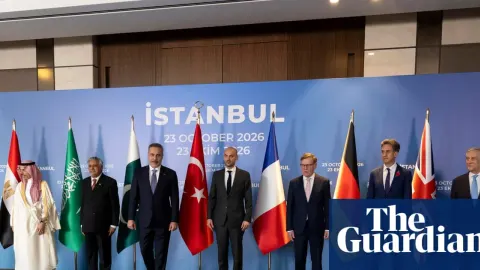
Istanbul & beyond
Frequently Asked Questions
Why did the US Navy Secretary resign so suddenly?
How is the Iran conflict affecting the UK economy?
What is the significance of the EU's €90 billion loan to Ukraine?
What happened with FTX and the startup Cursor?
Understanding Hybrid Warfare: Blending Force, Deception, and Influence
Hybrid warfare is a strategy that fuses conventional military force with irregular tactics, cyber attacks, economic pressure, and information operations. Rather than relying on a single type of combat, a hybrid approach seeks to exploit the vulnerabilities of an opponent across multiple domains simultaneously, making the conflict harder to detect, attribute, and counter.
The concept typically includes four pillars: kinetic (traditional armed forces), irregular (guerrillas, militias, proxy groups), cyber/electronic (malware, hacking, jamming), and informational/economic (propaganda, sanctions, trade manipulation). By coordinating these layers, a state can achieve strategic objectives while staying below the threshold that would trigger a full‑scale conventional response from adversaries.
Modern examples illustrate the versatility of hybrid warfare. Iran has employed it in the Strait of Hormuz, pairing naval drills and missile threats with cyber‑espionage and oil‑price manipulation to pressure shipping lanes without declaring war. Russia’s invasion of Ukraine blended regular troops with separatist militias, disinformation campaigns, and massive cyber attacks on critical infrastructure. China’s actions in the South China Sea combine coast‑guard patrols, legal claims, and economic incentives to assert control without overt military confrontation.
For policymakers, recognizing hybrid tactics is essential because traditional defense doctrines often overlook the non‑kinetic elements that can be equally decisive. Effective counter‑measures require integrated intelligence, resilient cyber defenses, coordinated diplomatic messaging, and flexible economic tools that can respond quickly to a blend of threats.
Understanding hybrid warfare helps citizens and analysts see beyond headline‑grabbing battles and appreciate the complex, multi‑layered nature of contemporary security challenges.