Despair Beneath the Veneer: Iranians Grapple with War Strains as Washington Debates 'Unauthorized' Conflict
بحران روانی در سایه جنگ؛ جدال در واشینگتن بر سر مشروعیت درگیری نظامی با ایران
As the US Senate erupts over Pete Hegseth’s handling of the Iran conflict, a profound sense of powerlessness takes hold within Iran’s borders. Meanwhile, global energy markets reel from a 9 million barrel supply gap caused by the ongoing blockade of the Strait of Hormuz.
At time of publishing
USD
177,150
Toman
Gold 18K
19.87M
Toman / gram
Bitcoin
$76,472
US Dollar
Tether
17,627.1
Toman
The "Smooth Veneer" of Resilience Amidst Iranian Despair
Beneath the surface of daily life in Iran, a profound sense of grief and powerlessness is taking root. While the streets of Tehran may appear functional to a casual observer, reports indicate that months of geopolitical upheaval and economic strangulation have pushed the collective psyche to a breaking point. Families are increasingly grappling with a dual burden: the immediate fear of military escalation and the slow-motion collapse of their financial security. Despite a slight recovery in the currency markets this hour—with the USD selling at 177,150 Toman, down from 178,850 (-1.0%)—the long-term outlook remains clouded by uncertainty, leading many to feel that their futures are being decided by forces entirely beyond their control.
This psychological strain is compounded by a loss of hope that was once fueled by the prospect of diplomatic breakthroughs. As the "smooth veneer" of normalcy wears thin, the reality of economic stress becomes impossible to ignore. Gold prices continue to climb, with 18k gold rising from 19,797,543 to 19,870,492 Toman (+0.4%), reflecting a desperate flight to safety among those who still have savings. For the average citizen, the daily struggle is no longer just about the price of bread or meat, but about maintaining a sense of dignity in an environment where the rules of the game change every hour based on headlines from Washington or the Persian Gulf.

Washington's Internal War Over the Iran Conflict
The political landscape in the United States has reached a fever pitch as Republican senators blocked a sixth attempt to pass a war powers resolution aimed at limiting military action in Iran. The debate has centered on Defense Secretary Pete Hegseth, who faced intense grilling from Democrats over what they describe as an "unauthorized war." Critics argue that the administration has bypassed constitutional requirements for congressional approval, leading the nation into a conflict that is draining resources and driving up costs for American households. Senator Jack Reed notably accused Hegseth of providing a "dangerously exaggerated" picture of military success, suggesting that the reality on the ground is far more precarious than the public is being led to believe.
This domestic political friction has significant implications for the region. As long as the US leadership remains divided on the endgame, the likelihood of a sustained or expanded conflict increases. For Iranian markets, this political gridlock in the West translates to continued volatility. The "Hormuz Premium" is now a permanent fixture in global trade, as evidenced by the rising cost of fuel even in the US, where California gas prices have surged to $6 per gallon. The lack of a clear diplomatic or military exit strategy means that the current state of high-tension equilibrium is likely to persist, keeping the Toman under pressure and gold prices at record highs.
The 9 Million Barrel Void: Energy Markets Under Siege
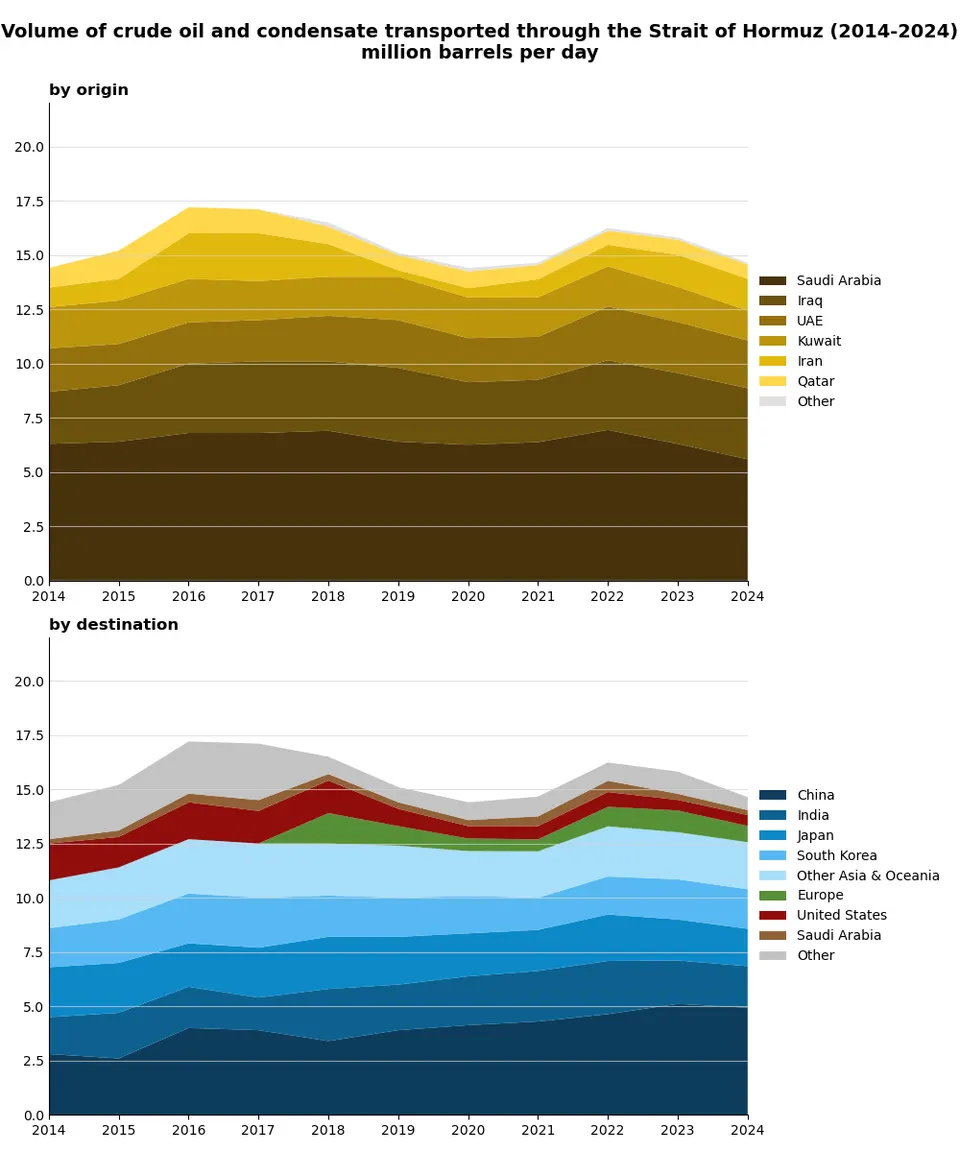
The full scale of the energy crisis triggered by the Strait of Hormuz blockade is finally coming into focus. New data from Vortexa reveals that approximately 9 million barrels per day of crude supply have been removed from the global market. While alternative routes through pipelines in Yanbu and Fujairah are operating at capacity, they are only managing to return about 3.6 million barrels per day to the system. This massive supply gap is the primary driver behind the global energy crunch that is now hitting the West Coast of the United States with unprecedented force. In California, the $6 per gallon milestone is being seen as a new, painful phase of the crisis, highlighting the vulnerability of global supply chains to regional instability.
European and British policymakers are similarly feeling the heat. The Bank of England and the European Central Bank both held interest rates steady this Thursday, citing the "excruciating choices" they face as fuel-driven inflation threatens to derail their economies. The dilemma is clear: raising rates further could trigger a deep recession, while cutting them could let inflation run rampant. For Iran, being at the epicenter of this energy earthquake means that while it possesses the resources the world needs, the geopolitical barriers to exporting those resources are currently insurmountable, leaving the domestic economy in a state of forced stagnation despite the global hunger for its oil.
Tech Tensions and Crypto’s $75K Support Floor
In the technology sector, Meta has issued a stark ultimatum to regulators in New Mexico, threatening to pull Facebook, Instagram, and WhatsApp from the state if forced to implement "technologically impractical" changes. This clash highlights the growing friction between big tech and local governments seeking to enforce stricter oversight. Meanwhile, the AI world remains transfixed by the Musk v. Altman trial, where newly released internal documents from OpenAI’s early days are shedding light on the ideological rift that led to the current competitive landscape. For Iranian users, who often rely on these platforms for both communication and business, any disruption in Meta’s global operations adds another layer of digital uncertainty.
In the crypto markets, Bitcoin has established a firm support zone around the $75,000 level. Despite the broader market volatility, spot BTC ETF flows have remained relatively stable, suggesting that institutional investors are viewing the current geopolitical turmoil as a long-term catalyst for decentralized assets. Bitcoin is currently trading at $76,472, holding steady as a digital alternative to traditional safe havens. For many in Iran, crypto continues to serve as a vital hedge against the Toman’s fluctuations, even as the global community grapples with the escalating threat of state-sponsored hacking groups who have already stolen billions in crypto assets this year.
Frequently Asked Questions
Why is there a 9 million barrel supply gap in the oil market?
What is the 'Hormuz Premium' affecting global prices?
Is Bitcoin still a safe haven for Iranians during this crisis?
The Strategic Chokepoint: How a Strait of Hormuz Blockade Shapes Global Energy and Iran’s Economy
The Strait of Hormuz, a narrow waterway only about 21 miles wide at its narrowest point, links the Persian Gulf with the open ocean. Roughly one‑fifth of the world’s oil consumption passes through this corridor each day, making it a linchpin of global energy security. Because the strait sits between Iran and the United Arab Emirates, any threat to its free flow—whether a naval blockade, mining, or missile attacks—immediately reverberates through oil markets, currency valuations, and even the price of gold.
When a blockade is threatened, oil traders price in a risk premium. Futures contracts for Brent and WTI can spike by several dollars per barrel, which in turn pushes up gasoline prices in distant markets like California, where a $6‑per‑gallon pump is already a political flashpoint. The ripple effect also reaches emerging economies that rely on cheap oil imports; their local currencies, such as the Iranian rial (IRR), often depreciate sharply against the U.S. dollar as foreign exchange reserves dwindle and inflation accelerates.
Iran’s economy is especially vulnerable because it depends heavily on oil export revenues to fund its budget and to support the rial’s stability. Sanctions have already limited Iran’s ability to sell oil on the open market, forcing it to use alternative currencies or barter arrangements. A Hormuz blockade would compound these pressures, potentially driving the USD/IRR exchange rate to historic lows and prompting Iranians to turn to assets like gold or Bitcoin as hedges against currency collapse.
Historically, the strait has been a flashpoint during regional conflicts. During the Iran‑Iraq War (1980‑88), both sides mined the waterway, causing temporary closures and sharp oil price spikes. More recently, in 2019, attacks on tankers near Hormuz led to brief disruptions and renewed calls for naval patrols. Each episode underscores how geopolitical tension can translate into immediate economic consequences for both the region and the world.
Understanding the strategic importance of the Strait of Hormuz helps explain why a seemingly local dispute can trigger global price swings, affect everyday fuel costs, and intensify economic stress within Iran—fueling everything from psychological strain among its citizens to debates in the U.S. Senate about the legality of an “unauthorized” conflict.