
Trump Claims Iran’s Military is ‘Decimated’ as Tether’s Reserve Buffer Shrinks by $4 Billion
ادعای ترامپ درباره «نابودی» قوای نظامی ایران و کاهش ۴ میلیارد دلاری ذخایر تتر
Donald Trump signals a hardline stance from Camp David, claiming Iran's military capabilities have been neutralized, while the global crypto market digests a significant drop in Tether’s excess reserves. Meanwhile, the Iranian Toman shows a slight 0.4% appreciation despite the heated rhetoric.
At time of publishing
USD
192,600
Toman
Gold 18K
18.58M
Toman / gram
Bitcoin
$63,027
US Dollar
Tether
193,871
Toman
Trump’s Camp David Rhetoric: ‘Iran is Decimated’
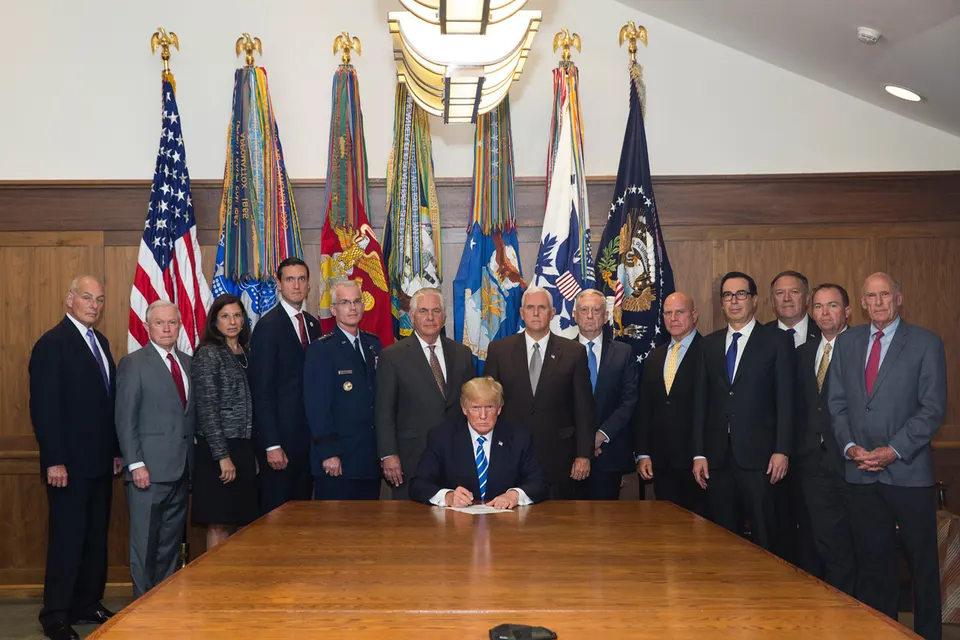
During a high-stakes cabinet meeting at Camp David, President Donald Trump delivered a blunt assessment of the ongoing tensions with Iran, claiming that the country’s military infrastructure has been effectively neutralized. Speaking to reporters, Trump asserted that Iran currently possesses "no Navy, no Air Force, and no anti-aircraft capability," suggesting that the administration's pressure campaign has left the regional power in a state of total military decay. While these claims remain unverified by independent military analysts—who often point to Iran's persistent drone and missile capabilities—the rhetoric serves as a clear signal that the White House is not currently interested in de-escalation. Trump emphasized that the U.S. is "hitting them very hard" and characterized the strategy as a necessary path to victory, though he stopped short of defining what a final diplomatic or military 'win' would look like.
This shift in tone coincided with a notable hesitation regarding Ukraine. Trump expressed deep skepticism about fulfilling President Zelenskyy’s request for Patriot missile manufacturing technology, calling it a "big step" and a "hard thing to give away." He warned that providing such advanced defense systems could backfire, stating that "people can someday turn on you." This transactional approach to geopolitics—coupling aggressive rhetoric toward Iran with a more guarded stance on European defense—has left markets in a state of cautious observation. For Iranian readers, this suggests a continued era of maximum pressure where any hope for sanctions relief remains distant, keeping the Toman under long-term structural pressure despite occasional short-term rallies.
Tether’s Financial Shift: A $4 Billion Reserve Correction
Tether, the issuer of the world’s most widely used stablecoin (USDT), released its Q2 2026 financial results, revealing a significant shift in its balance sheet. The company’s excess reserve buffer—the capital held above the 1:1 backing of the tokens in circulation—fell by more than $4 billion. This drop comes as the company reported a net operating profit of $1.5 billion for the quarter, a sharp decline from the $4.9 billion net profit reported in the same period last year. While Tether remains profitable and continues to diversify its holdings—adding 14 metric tons of gold and approximately 1,800 Bitcoin to its reserves this quarter—the shrinking buffer has raised eyebrows among institutional analysts who monitor the stablecoin’s ability to withstand extreme market volatility.
For the millions of Iranians who utilize USDT as a digital hedge against the Toman’s inflation, the health of Tether’s reserves is a matter of personal financial security. The reduction in the excess buffer suggests that while the system is currently stable, the aggressive profit margins seen during the height of the 2025 bull market are beginning to normalize. Tether’s management attributed the change to shifting financial conditions and the costs of expanding its broader ecosystem into AI and energy infrastructure. However, the data confirms that even the giants of the crypto world are not immune to the cooling global economic environment. In the local market, USDT (Toman) is currently trading at 193,871, maintaining a slight premium over the physical dollar rate, reflecting its continued role as the primary exit ramp for domestic capital.
The Ceuta Crisis: Territorial Integrity and Migration Pressures
In Europe, a massive humanitarian and political crisis has unfolded in the Spanish enclave of Ceuta, where upwards of 60,000 migrants crossed from Morocco in a matter of days. Spanish Prime Minister Pedro Sanchez has labeled the surge a "violation of territorial integrity," highlighting the growing friction between the EU and North African transit states. While approximately 48,000 individuals have already been returned to Morocco, the event has left nearly three dozen people dead and sparked a fierce debate over border security and the ethics of migration management. The crisis is not merely a local Spanish issue; it represents a broader systemic failure in Mediterranean migration policy that often leads to sudden, destabilizing border events.
This geopolitical instability in the Mediterranean often ripples through global risk sentiment. When European borders face sudden shocks, it frequently strengthens the U.S. Dollar as a safe-haven asset, which in turn puts pressure on emerging and frontier currencies like the Toman. Furthermore, the use of migration as a political lever—as Spain implies Morocco has done—parallels the complex 'gray zone' tactics seen in Middle Eastern geopolitics. As the Spanish government struggles to maintain its pro-immigration stance amidst this 'invasion' rhetoric from the opposition, the incident serves as a reminder of how quickly humanitarian issues can transform into national security emergencies that dictate international trade and diplomatic priorities.
AI in the Fog of War: Google Earth’s Reality Crisis
A new controversy has erupted in the tech world regarding the integration of AI image generators within Google Earth. Researchers have demonstrated that simple text prompts can now be used to generate "reality-warping" images—such as fake bomb craters near hospitals in Gaza or non-existent refugee camps at the Mexican border—directly onto the platform’s satellite and 3D imagery. This capability, highlighted by Digital Digging’s Henk van Ess, poses a profound threat to the integrity of open-source intelligence (OSINT). In conflict zones like the Middle East, where satellite imagery is frequently used by journalists and human rights groups to verify claims of war crimes, the ability to manufacture fake geographic evidence could lead to catastrophic misinformation.
Google has acknowledged the issue, but the development underscores the double-edged nature of AI in 2026. For the average user, these tools offer incredible creative potential; for state actors and propagandists, they offer a way to rewrite the physical reality of the planet in the digital realm. As we move further into an era where 'seeing is no longer believing,' the premium on verified, traditional reporting will only increase. For those following the various regional conflicts involving Iran and its proxies, this technological shift means that digital evidence must be scrutinized with unprecedented rigor, as the line between a real-time satellite update and an AI-generated fabrication becomes increasingly blurred.
Frequently Asked Questions
Why did Tether’s excess reserves fall by $4 billion?
What did Trump mean by saying Iran has 'no Navy or Air Force'?
How did the Iranian Toman react to the latest news from Camp David?
Is the AI image generation in Google Earth a security risk?
Stablecoin Reserves: The Backbone of Digital Dollars
Stablecoins are a unique class of cryptocurrencies designed to minimize price volatility, aiming to maintain a stable value relative to a "stable" asset like the U.S. dollar, gold, or another fiat currency. Unlike Bitcoin or Ethereum, whose prices can fluctuate wildly, stablecoins like Tether's USDT strive for a 1:1 peg with the dollar, making them crucial for traders seeking to preserve capital in the volatile crypto market or for making everyday digital payments without currency risk. Their utility lies in bridging the traditional financial system with the decentralized world of blockchain.
The stability of a stablecoin like USDT fundamentally relies on its "reserves." These reserves are assets held by the issuer to back every stablecoin token in circulation. Ideally, for every USDT token issued, there should be one U.S. dollar or an equivalent asset held in reserve, providing confidence that users can always redeem their digital tokens for fiat currency at par. The quality and transparency of these reserves are paramount, as they directly impact the stablecoin's ability to maintain its peg and the trust users place in it.
The composition of these reserves can vary significantly, ranging from highly liquid assets like cash and U.S. Treasury bills to less liquid or riskier assets such as commercial paper, corporate bonds, or even other cryptocurrencies. When a stablecoin's "reserve buffer shrinks," as mentioned in the headline, it typically refers to a reduction in the value or liquidity of the assets backing the stablecoin, or a decrease in the ratio of reserves to outstanding tokens. This can raise concerns among investors about the stablecoin's ability to withstand redemption pressures, potentially leading to a "de-pegging" event where the stablecoin trades below its intended value, undermining its core purpose of stability.
Topics
Related Articles