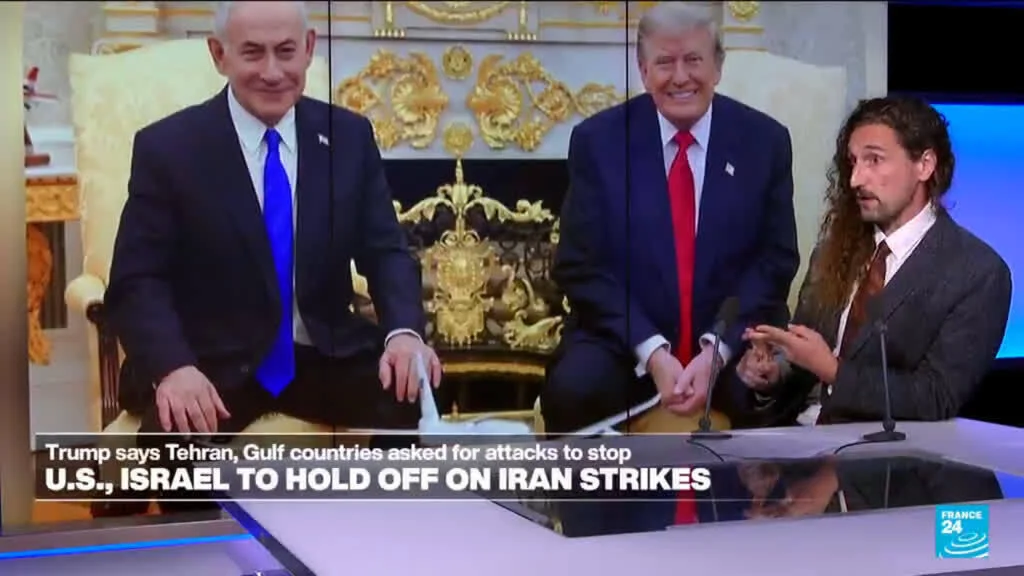
Trump Pauses Iran Strikes for 'Rapid Deal' as Tehran Gold and USD Prices Retreat
توقف حملات احتمالی ترامپ به ایران؛ ریزش قیمت دلار و طلا در بازار تهران
US President Donald Trump has signaled a pause in potential strikes on Iran, citing a push for a 'rapid deal' following regional mediation. This shift has triggered a sharp correction in Tehran’s markets, with gold and currency prices sliding as war fears dissipate.
At time of publishing
USD
191,800
Toman
Gold 18K
18.27M
Toman / gram
Bitcoin
$63,068
US Dollar
Tether
192,022
Toman
The Pivot Toward Diplomacy: Trump Halts Strike Plans
In a significant shift that has sent ripples through global and local markets, US President Donald Trump has announced a pullback from plans for major new strikes on Iran. This decision comes after weeks of escalating rhetoric that had pushed the region to the brink of open conflict. Trump stated late Saturday that the United States would hold off on military action, provided a diplomatic 'deal' can be reached quickly. This reversal reportedly followed a high-stakes phone call with Saudi Crown Prince Mohammed bin Salman, who urged de-escalation due to fears that Iranian retaliation could devastate the energy infrastructure of Gulf states. While Trump claimed that Israel is aligned with this pause, Prime Minister Benjamin Netanyahu has notably remained silent, suggesting a possible rift in the Western-Israeli coalition regarding the 'maximum pressure' strategy.
Tehran’s response to this development has been characterized by deep-seated skepticism. Official sources and analysts in Iran have labeled Trump's comments as part of a 'psychological operation' designed to keep the Iranian leadership off balance. Despite this official wariness, the immediate threat of a kinetic strike appears to have receded, replaced by a renewed focus on back-channel negotiations and regional mediation. For the average observer, this represents a temporary sigh of relief, though the underlying tensions regarding the Strait of Hormuz and Iran's nuclear program remain unresolved. The 'rapid deal' Trump envisions remains ill-defined, leaving many to wonder if this is a genuine diplomatic opening or merely a tactical pause before a different form of pressure is applied.

Tehran Markets React: Gold and USD See Sharp Corrections
The immediate beneficiary of this geopolitical de-escalation has been the Iranian consumer and trader, as the 'war premium' that had been baked into asset prices began to evaporate. In the last 24 hours, the USD/IRR exchange rate moved from 194,400 to 191,800, representing a 1.3% decrease. This move reflects a sudden influx of liquidity as speculators who had hoarded hard currency in anticipation of conflict began to offload their positions. The market's reaction suggests that while the long-term economic outlook remains challenged by sanctions, the immediate fear of a catastrophic military event was the primary driver of the recent price spikes.
The gold market saw even more dramatic movements, as the metal often serves as the ultimate safe haven during times of military threat. Gold 18k per gram dropped from 18,733,551 to 18,269,541 Toman, a significant 2.5% decline in just one day. Similarly, the benchmark Emami coin fell from 188,000,000 to 184,000,000 Toman, a 2.1% drop. These figures indicate a massive cooling of the 'war fever' that had gripped the Tehran Bazaar. Traders are now closely watching the 190,000 Toman level for the Dollar; if diplomacy continues to be the dominant headline, we may see further retracement, though any hawkish comment from Washington or Jerusalem could instantly reverse these gains.

Grim Discoveries and Global Legal Battles
Beyond the geopolitical theater, a dark story has emerged from Athens where Greek police have arrested a 26-year-old foreigner in connection with the death of a Scottish woman. The body of 38-year-old Elisabeth-Jane Ross was discovered hidden inside a suitcase in a derelict building, a case that has shocked the local expatriate community. The suspect, who was found with a replica pistol and a knife, has reportedly admitted to the killing, leading to charges of manslaughter and robbery. This tragic event highlights ongoing concerns regarding safety and crime in urban European centers, even as the continent grapples with larger political crises.
Meanwhile, in Australia, a high-profile legal battle has commenced as the trial of 85-year-old former broadcaster Alan Jones begins in Sydney. Jones faces 22 charges related to indecent assault and sexual touching involving six different complainants between 2003 and 2020. The trial is expected to last four months and feature testimony from over 70 witnesses. This case is being closely watched as a landmark moment for the Australian justice system, reflecting a broader global movement toward holding powerful media figures accountable for historical misconduct. In a separate but equally somber report, advocates in New South Wales are sounding the alarm over a record number of First Nations deaths in prison custody, calling for urgent systemic reform as the toll continues to rise despite years of protests.

Tech Wars and the August Streaming Lineup
In the world of technology and markets, the battle for the 'budget' consumer is heating up. Apple’s recent gamble on the MacBook Neo—a more affordable entry into its laptop ecosystem—is reportedly sparking a price war among rival manufacturers. As traditional PC makers rethink their offerings to compete with Apple’s silicon efficiency at lower price points, the consumer stands to benefit from higher performance in the sub-$800 category. This shift marks a departure from Apple's traditional high-margin strategy, suggesting the company is looking to aggressively expand its user base in a stagnating global hardware market.
For those looking to escape the heavy news cycle, August 2026 is shaping up to be a major month for digital entertainment. Streaming giants like Netflix, Amazon, and Apple TV+ are releasing highly anticipated seasons of 'Ted Lasso,' 'Reacher,' and 'Outer Banks.' While these stories may seem trivial compared to the threat of war or economic collapse, the financial health of these streaming platforms remains a key indicator of consumer discretionary spending. As inflation remains a persistent shadow over the global economy, the ability of households to maintain multiple streaming subscriptions is a metric Wall Street is watching closely to gauge the true strength of the middle class.
Frequently Asked Questions
Why did Donald Trump decide to pause potential strikes on Iran?
How did the Tehran market respond to the de-escalation news?
What is the 'MacBook Neo' mentioned in the tech section?
What was the reaction from Iranian officials to Trump's announcement?
Geopolitical Risk and Market Reactions: The Impact of De-escalation on Gold and Currency
Geopolitical risk refers to the potential for political instability, conflict, or other international events to disrupt markets and economies. These risks introduce uncertainty, which investors typically dislike. When geopolitical tensions escalate, such as the threat of military action or sanctions, markets often react by shifting capital towards perceived safe-haven assets. These are investments that are expected to retain or increase in value during times of market turbulence, with gold being a prime example due to its historical role as a store of value, and the U.S. dollar often serving as a global safe haven currency due to its stability and liquidity.
Conversely, when geopolitical tensions de-escalate, the dynamic shifts. The news of a pause in strikes and the prospect of a deal, as seen in the headline, signals a reduction in perceived risk. This lessens the immediate need for investors to hold onto safe-haven assets. Consequently, we often observe a retreat from these assets: gold prices tend to fall as investors move capital back into riskier, but potentially higher-yielding, investments. Simultaneously, local currencies in the affected region, which might have weakened during the period of heightened tension, can begin to stabilize or even strengthen against major currencies like the U.S. dollar, reflecting a renewed confidence in the region's economic stability.
In the context of the headline, the "retreat" of Tehran gold and USD prices directly illustrates this principle. A potential "rapid deal" between major powers and Iran implies a reduction in the immediate threat of conflict and a pathway towards greater stability. For Iran, which has faced significant economic pressures and currency volatility due to sanctions and political uncertainty, any sign of de-escalation can lead to a strengthening of the Iranian Rial (IRR) against the U.S. dollar, as the perceived risk of holding the local currency diminishes. Similarly, the global demand for gold as a hedge against broad geopolitical instability would likely wane, contributing to its price drop.
Understanding this interplay is crucial for anyone following global news. It highlights how political decisions and international relations are not abstract concepts but have tangible, immediate effects on everyday economic indicators, from the price of commodities to the value of national currencies. The market acts as a barometer, quickly adjusting to changes in the perceived level of global and regional stability.