Trump Issues 'Annihilate' Ultimatum to Tehran as Gold Prices Correct 2.3% in Iranian Market
اولتیماتوم «نابودی» ترامپ در سازمان ملل همزمان با ریزش ۲.۳ درصدی قیمت طلا در بازار تهران
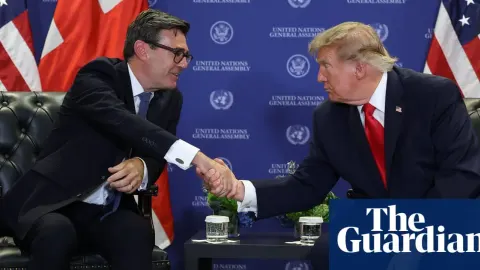
At the UN General Assembly, President Trump presented a stark choice for Iran between a 'deal' and 'annihilation,' while domestic Iranian markets saw a significant 2.3% drop in gold prices. Meanwhile, Bitcoin stabilizes near $86,000 following record ETF inflows of $1.7 billion.
At time of publishing
USD
231,200
Toman
Gold 18K
23.37M
Toman / gram
Bitcoin
$86,335
US Dollar
Tether
231,153.991
Toman
Trump’s Binary Choice: Diplomacy or Destruction at the UN
President Donald Trump’s appearance at the United Nations General Assembly has sent shockwaves through the diplomatic community, as he moved away from traditional de-escalation rhetoric to issue a direct ultimatum. In a series of comments that have dominated the 11:00 Tehran hour, Trump stated that he must decide whether to pursue a definitive deal with Iran or, in his words, "annihilate" the country. This high-stakes language, while familiar to those who followed his first term's "maximum pressure" campaign, carries renewed weight in 2026 as the global security landscape remains fractured by regional conflicts and energy supply disruptions.
While Trump's rhetoric was intended to project strength, it has highlighted a deep division among world leaders. Many European and Asian representatives have pointedly avoided repeating his aggressive framing, instead calling for a return to established legal frameworks and structured negotiations. For the Iranian public, this volatility in New York translates directly into economic anxiety. The threat of total destruction, even if viewed as hyperbole by some analysts, reinforces the perception that the path to sanctions relief remains fraught with extreme geopolitical risk, keeping the Toman under constant pressure despite minor daily fluctuations.
Gold and Currency: A Sharp Correction Amid Political Noise
Despite the aggressive headlines from the UN, the domestic Iranian market showed a surprising corrective trend this morning. Gold 18k per gram saw a significant decrease of 2.3%, dropping from 23,927,697 to 23,373,655 Toman. This move was mirrored in the coin market, where the Emami coin fell by 1.1%, moving from 237,500,000 to 235,000,000 Toman. Such a correction often suggests that the market had already priced in a certain level of geopolitical tension and is now reacting to a temporary exhaustion of buyers at record-high levels.
In the currency market, the US Dollar showed relative stability with a slight downward bias. The USD sell rate moved from 231,500 to 231,200 Toman, a marginal decrease of 0.1%. This stability is somewhat precarious; traders are likely waiting for the official Iranian response to Trump’s comments before committing to a new direction. The slight strengthening of the Toman today may be attributed to central bank interventions or a tactical pause by large-scale speculators who are assessing whether Trump's threats will lead to immediate policy changes or remain confined to the halls of the United Nations.
Bitcoin’s $1.7 Billion Surge Meets Technical Resistance
On the global stage, Bitcoin continues to be the dominant narrative in the financial world, though it is currently facing a technical cooling-off period. After reaching overbought highs near $86,388, the premier cryptocurrency has pulled back slightly to settle around $86,335. This price action comes on the heels of massive institutional interest, with US spot Bitcoin ETFs recording a staggering $1.7 billion in net inflows over just two days. Investors are increasingly viewing BTC as a legitimate hedge against the very kind of geopolitical instability currently being broadcast from the UN podium.
However, the "overbought" status signaled by technical indicators suggests that a period of consolidation is necessary. As Bitcoin remains above the estimated cost basis for most holders, the market is in a "profit-taking" zone. For Iranian investors, who have increasingly turned to USDT and BTC to preserve capital against Toman devaluation, the $86,000 level represents a critical psychological benchmark. If Bitcoin can hold this support despite the current pullback, it may signal a further leg up toward the $90,000 mark, especially as the Trump administration considers appointing a dedicated "AI and Crypto Czar" to streamline digital asset policy in the United States.
Regional Security and the Araghchi Doctrine
While the focus remains on New York, Iranian Foreign Minister Abbas Araghchi has been reinforcing regional alliances to counter Western pressure. In recent meetings with Iraqi officials, Araghchi emphasized the critical importance of border security and counterterrorism cooperation. This move is designed to ensure that regardless of the rhetoric from Washington, Iran’s immediate neighbors remain stable and cooperative. By securing the border with Iraq, Tehran aims to mitigate the risk of insurgent movements that often exploit periods of high international tension.
Araghchi also took the opportunity to lash out at European leaders, accusing them of moral hypocrisy. He argued that Europe cannot claim to uphold the "rule of law" while supporting what he described as US-Israeli military aggression. This stance suggests that Tehran is not currently in a mood for concessions, despite Trump’s "deal or annihilate" ultimatum. For the reader, this means that the diplomatic stalemate is likely to persist, keeping market volatility high and making any long-term economic planning difficult as the government prioritizes regional defense over international reintegration.
Watch
Trump defends Iran war and threatens annihilation at UN General Assembly
PBS NewsHour
Frequently Asked Questions
Why did gold prices drop in Iran despite Trump's threats?
What is the significance of the $1.7 billion Bitcoin ETF inflow?
How is the Iranian government responding to the UNGA developments?
Geopolitical Risk and its Impact on Currencies and Alternative Assets
Geopolitical risk, such as the "annihilate" ultimatum mentioned in the headline, refers to the potential for political events to disrupt the normal course of economic activity. These events, ranging from international disputes and threats of conflict to the imposition of sanctions, create significant uncertainty in financial markets. For economies already under international pressure, like Iran's, such pronouncements can have immediate and profound effects on domestic asset prices and currency stability.
One of the primary ways geopolitical risk manifests is through its impact on a nation's currency. Threats of severe sanctions or military action can deter foreign investment, disrupt trade routes, and lead to capital flight, where investors withdraw funds from the country. This reduced demand for the local currency, coupled with increased uncertainty, typically results in its rapid depreciation against major international currencies. For instance, the Iranian Toman's exchange rate is highly sensitive to external political developments, often weakening significantly when tensions escalate.
In response to currency depreciation and the looming threat of inflation, citizens and investors often seek to protect their wealth by turning to alternative assets. Gold, historically considered a safe-haven asset, becomes particularly attractive during times of instability. Its value is perceived as more stable than a rapidly depreciating local currency, leading to increased demand and price surges in local markets, as seen with the Emami coin in Tehran. Similarly, digital assets like stablecoins (e.g., USDT, whose price against the Toman is mentioned) can also serve as a means to bypass traditional banking systems and hedge against local currency volatility, though they come with their own set of risks.
This flight to alternative assets highlights a broader economic challenge: the erosion of confidence in the domestic financial system. When a national currency loses significant value, the purchasing power of citizens diminishes, savings are eroded, and the overall economic stability is threatened. Understanding this dynamic is crucial for comprehending how global political rhetoric can translate directly into tangible economic consequences for individuals and markets within targeted nations.